Table of Contents
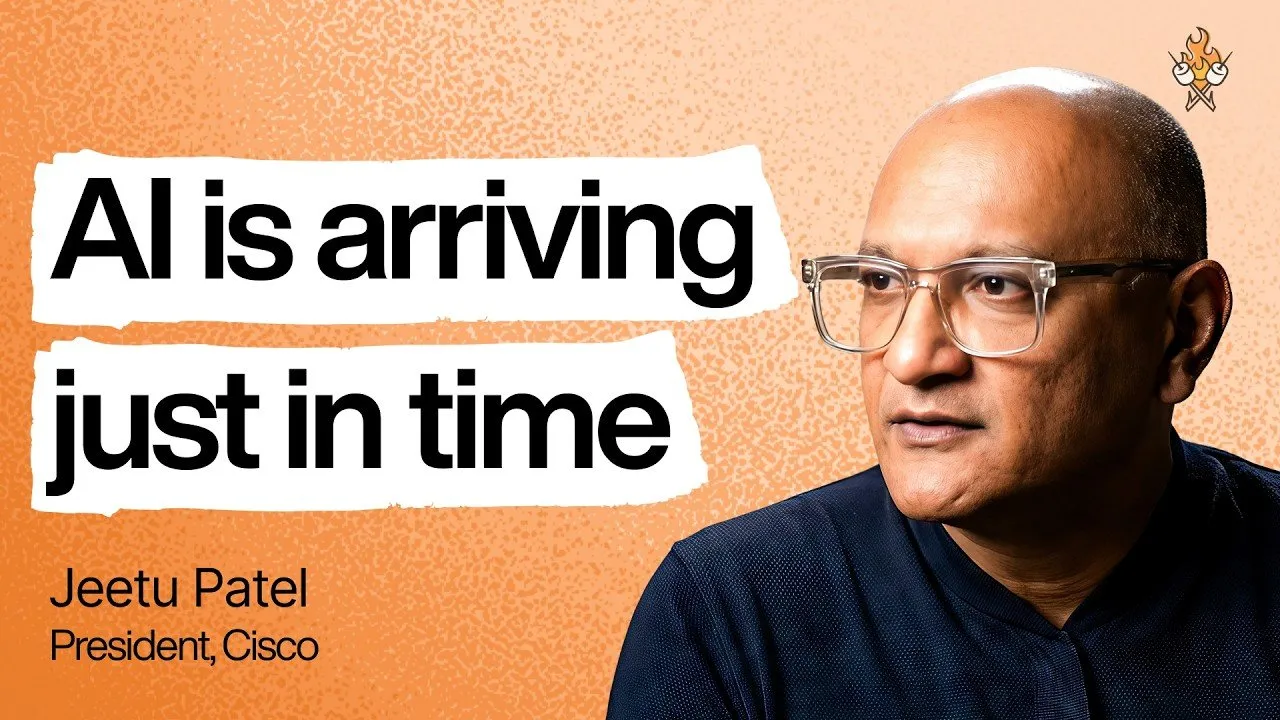
Jeetu Patel, the Chief Product Officer and President at Cisco, views the current artificial intelligence revolution as far more than a productivity booster. To Patel, AI is a fundamental necessity for the continued survival of humanity. While many still associate Cisco with legacy hardware like routers or conferencing tools like WebEx, Patel is currently leading a massive internal and external pivot to position the company as the essential connective tissue for the AI era. By transforming a 90,000-person organization into an AI-forward powerhouse, he offers a masterclass in how legacy enterprises can regain their "innovation mojo" through radical transparency, strategic focus, and a relentless commitment to stamina over raw intellect.
Key Takeaways
- AI as a Demographic Solution: AI is critical to counteracting declining birth rates and ensuring that an aging global population can be cared for despite a shrinking workforce.
- The "Right to Win" Framework: Successful product strategy requires "permission to play"—a logical entry point where your company’s existing distribution and DNA give you an unfair advantage.
- Stamina Over Intellect: Patel argues that while intelligence is common, "hunger" and the persistence to stay in the game are the true differentiators of successful leaders.
- Eliminating "Packet Loss" in Communication: Leaders must own the company narrative directly rather than delegating it, preventing the message from becoming distorted as it moves down organizational layers.
- Public Critique, Private Trust: Effective leadership involves establishing enough trust to debate and critique ideas openly in public while providing deep personal support in private.
The Demographic Imperative: Why AI is Essential for Survival
In many circles, AI is discussed through the lens of job displacement and economic disruption. However, Patel highlights a more pressing concern: the global demographic shift. As birth rates decline, the world faces a future where a massive percentage of the population will be elderly without enough younger workers to provide care or maintain infrastructure. In this context, AI is not a luxury; it is a vital tool to fill the labor gap and prevent widespread human suffering.
Patel notes that we are entering an era of "exponentiality across multiple dimensions." While we previously used AI for simple data aggregation, we are moving toward a phase where AI generates original insights that do not yet exist in the human corpus of knowledge. This shift transforms AI from a tool into a teammate, augmenting human capacity to solve previously "unsolvable" problems in medicine, housing, and energy.
"Survival of humanity depends on a successful AI... if you have 60% of your population where you don't have enough people to take care of them, that could cause a lot of human suffering."
Strategic Moats: The "Permission to Play"
One of the most profound strategic frameworks Patel shares is the concept of the Right to Win. Many companies fail because they attempt to enter markets where they have no "permission to play." This permission is granted when a company’s entry into a new category feels logical to the customer based on their existing brand promise and distribution channels.
For Cisco, the permission to play in AI comes from its 40-year history in networking. As AI models outgrow single GPUs, they require massive clusters of servers that must be perfectly synchronized. Cisco provides the "connective tissue"—the networking, optics, and security—that allows these massive compute clusters to function as a single unit. By focusing on these core strengths, Cisco avoids the "slop" of entering markets where they lack a competitive advantage.
The Hierarchy of Company Success
Patel utilizes a six-part framework for evaluating the strength of a business, stack-ranked in order of importance:
- Timing: The variable you control the least but matters the most.
- Market: A great market can pull a mediocre team up; a bad market will drag a great team down.
- Team: A well-rounded group where members complement each other’s weaknesses.
- Product: The soul of the company and the primary vehicle for value delivery.
- Brand: Once "brand mojo" is lost, it is nearly impossible to resurrect.
- Distribution: The scaled mechanism for getting the product to the masses.
Leading at Scale: Avoiding "Packet Loss"
Managing 30,000 people requires a different communication architecture than a small startup. Patel warns against the "telephone game," where a leader's message is cascaded through seven or eight layers of management, losing intensity and clarity at every step. He refers to this as packet loss.
To combat this, Patel insists that leaders must be the primary custodians of the company story. Storytelling should not be a marketing exercise conducted after a product is built; it should be the foundational reason why the product is built. By owning the narrative and speaking directly to the front lines, leaders ensure that the "soul" of the business remains intact, even as the organization scales.
"Don't delegate the storytelling. The story is not a marketing exercise after you built the product. The story is why you build the product to make the story come real."
The Human Element: Stamina and Radical Transparency
One of Patel’s most counterintuitive leadership principles is his disagreement with the standard advice to "praise in public, criticize in private." He argues that in a high-stakes environment, ideas must be debated and critiqued openly to ensure the best outcome. However, this is only possible if a deep foundation of trust has been built in private first.
Patel also emphasizes that stamina trumps intellect. In Silicon Valley, intelligence is a baseline requirement, but it is rarely the deciding factor for long-term success. Success belongs to those with the "staying power" to remain in the game when things get difficult. He cites his former boss, Aaron Levy of Box, as a prime example of someone whose conviction and persistence outweighed all other factors.
Lessons from the Front Lines
- Vulnerability is a Strength: Patel recounts a personal story about his mother to emphasize the importance of not being "stingy with words." Being explicit about appreciation and love is as necessary in business as it is in life.
- Unlearning is Required: Experience can sometimes "jade" a leader. The most effective innovators combine the pattern recognition of experience with the fresh, unbiased questions of inexperience.
- The "Be Useful" Philosophy: Ultimately, career success is found by picking hard problems that attract the best people and focusing on being useful to the ecosystem rather than seeking individual glory.
Conclusion
Jeetu Patel’s transformation of Cisco is a reminder that innovation is a choice made every day, regardless of a company's size or age. By focusing on the "mega-trends" rather than the "hype cycles," and by prioritizing human connection and radical clarity, leaders can navigate even the most disruptive technological shifts. As AI continues to evolve, the most successful organizations will be those that view the technology not as a threat, but as an essential teammate in the quest to solve humanity’s greatest challenges.
For those looking to follow in his footsteps, Patel’s advice is simple: seek out a platform that provides a springboard, be obsessed with preparation, and never underestimate the power of persistence. As he puts it, "Luck does present itself, but you must be extremely prepared to capitalize on it."