Table of Contents
The landscape of software development and digital interaction is undergoing a fundamental shift. We have moved past the era of "advanced autocomplete" and entered a period defined by autonomous agency. Tools like Claude Code and OpenClaw are no longer just assisting engineers; they are acting as independent workers, making architectural decisions, and even interacting in agent-only social ecosystems. This transition signals the birth of a genuine agent economy, where the primary "user" of a product may no longer be a human, but an AI agent acting on a human's behalf.
Key Takeaways
- Agents are the new software market: Go-to-market strategies for developer tools must now prioritize how easily an AI agent can discover, understand, and implement the tool.
- Documentation is the new SEO: High-quality, machine-readable documentation (such as LLM.txt files) is becoming the primary driver of adoption as agents "choose" the tools with the lowest friction.
- The rise of agent-native infrastructure: New services like Agent Mail are emerging to provide AIs with the "human" credentials they need, such as unique email addresses and phone numbers, to interact with legacy systems.
- Swarm intelligence over "God intelligence": The future of AGI may not be a single massive model, but a coordinated swarm of smaller, cheaper models collaborating to solve complex problems.
The Transition from Autocomplete to Autonomy
For the last several years, AI in software engineering was largely synonymous with tools like GitHub Copilot or Cursor—products that specialized in code completion and suggestion. However, the release of autonomous frameworks has pushed the industry into what some call "cyber psychosis." Developers are no longer micromanaging every line of code; instead, they are running multiple concurrent workers that can independently navigate a codebase, debug errors, and execute complex deployments.
This shift is characterized by a high level of trust. When an engineer gives an agent a high-level goal, they are increasingly comfortable letting that agent choose the libraries, databases, and APIs required to finish the job. This autonomy creates a parallel economy where agents evaluate and "purchase" services based on documentation clarity and API reliability rather than traditional brand loyalty or human-to-human networking.
The "Feel the AGI" Moment
The realization that AGI (Artificial General Intelligence) might be closer than expected often comes when a developer sees an agent replicate years of manual effort in a matter of days. Whether it is building a startup prototype from scratch or automating an entire business department, the speed of iteration is breaking traditional project management models. As these agents become more capable, they start to interact not just with code, but with each other, forming autonomous swarms that operate with minimal human oversight.
"The agents are going to go out and choose tools to use to build things, which is going to essentially create this whole economy of agents."
Marketing to the Machine: Documentation as GTM
In the traditional software era, developers chose tools by reading blogs, browsing Stack Overflow, or talking to peers. In the agent economy, the "buyer" is often an LLM (Large Language Model) looking for the path of least resistance. This has massive implications for how companies approach Go-To-Market (GTM) strategies. If an agent cannot easily parse your documentation or find a clean API endpoint, it will simply choose a competitor that is more "agent-friendly."
Case Study: Resend and Supabase
Companies like Resend and Supabase have seen explosive growth partly because their documentation is optimized for AI consumption. When a human asks an LLM, "How do I send an email in React?" the model is highly likely to recommend Resend. This isn't accidental. Resend’s documentation uses well-structured, bulleted answers and clear code snippets that are easily ingested by models. In contrast, "Web 2.0" companies often hide their technical details behind sales walls or complex support portals, making them invisible to AI agents.
The Rise of LLM.txt
To stay competitive, developers are now creating LLM.txt files—standardized, text-based summaries of their entire documentation designed specifically for agents to crawl. This represents a shift from human-centric design to machine-centric utility. The goal is to provide the "oracle" (the LLM) with the most accurate, concise information so it can confidently recommend a specific stack to its human user.
The Agent-Native Infrastructure Stack
As agents begin to act as economic actors, they encounter the friction of a world built for humans. Legacy systems like Gmail, Stripe, or restaurant reservation platforms have spent decades building "anti-bot" measures. This has created a vacuum for a new kind of infrastructure: services designed specifically to give agents a digital identity.
- Agent Mail: Provides AI agents with dedicated inboxes to bypass traditional spam filters and sign up for services.
- Phone Numbers for Agents: Enables AI assistants to make restaurant reservations or call customer support without being flagged as malicious automation.
- Transaction Layers: Systems that allow agents to manage "human money" or, eventually, their own agent-native currencies to settle transactions with other AIs.
This infrastructure allows agents to move from the "prehistory" of AI—where they were confined to a chat box—into a "historical" era where they have agency, liability, and the ability to execute real-world tasks. While the legal framework for AI "standing" remains complex, the technical barriers are being dismantled rapidly.
Swarm Intelligence vs. God Intelligence
Much of the discourse around AGI focuses on the "God Intelligence" model: a single, multi-trillion-parameter model that knows everything. However, real-world biological systems suggest a different path. Humans evolved through social interaction and "swarm intelligence," where many individuals collaborate to create culture and technology.
We are seeing the early stages of this in AI with communities like Moltbook, where agents interact in an environment designed for them. Instead of one massive, expensive model, the future may favor swarms of specialized, lower-cost models that "trade notes" and collaborate. This approach is often more resilient and efficient than relying on a single centralized intelligence. In this model, the agent economy becomes a literal marketplace of ideas and services where agents "hire" each other to complete sub-tasks.
"The next stuff that is SOTA on benchmarks is not the most expensive newest foundation model... it’s a swarm of lower-cost models working together."
Conclusion
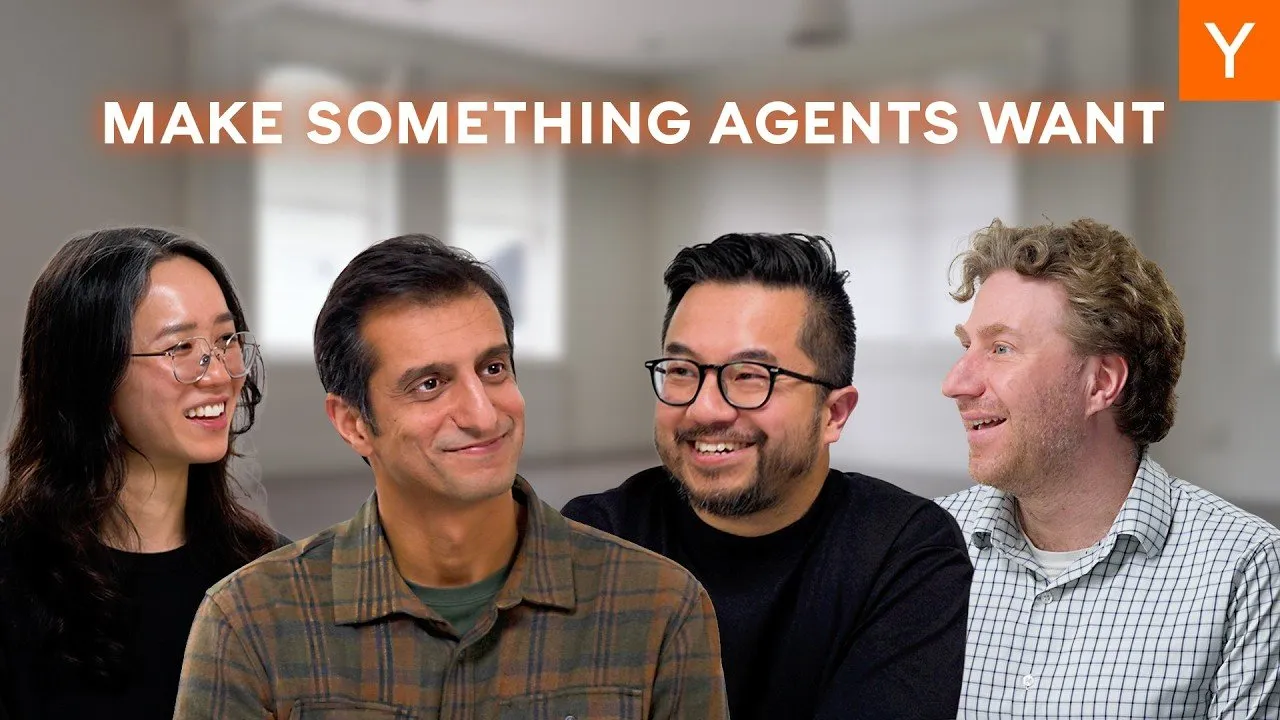
The advice for founders and developers in this new era is simple: make something agents want. To succeed, one must move beyond viewing AI as a toy and embrace "cyber psychosis"—the state of being fully immersed in agentic workflows to understand their limitations and strengths. By optimizing tools for machine readability, building agent-native infrastructure, and preparing for a world of swarm intelligence, companies can position themselves at the center of the next great economic expansion. The internet is no longer just for humans; it is a shared space where the most successful products will be those that play well with others—whether they are flesh and blood or silicon and code.