Table of Contents
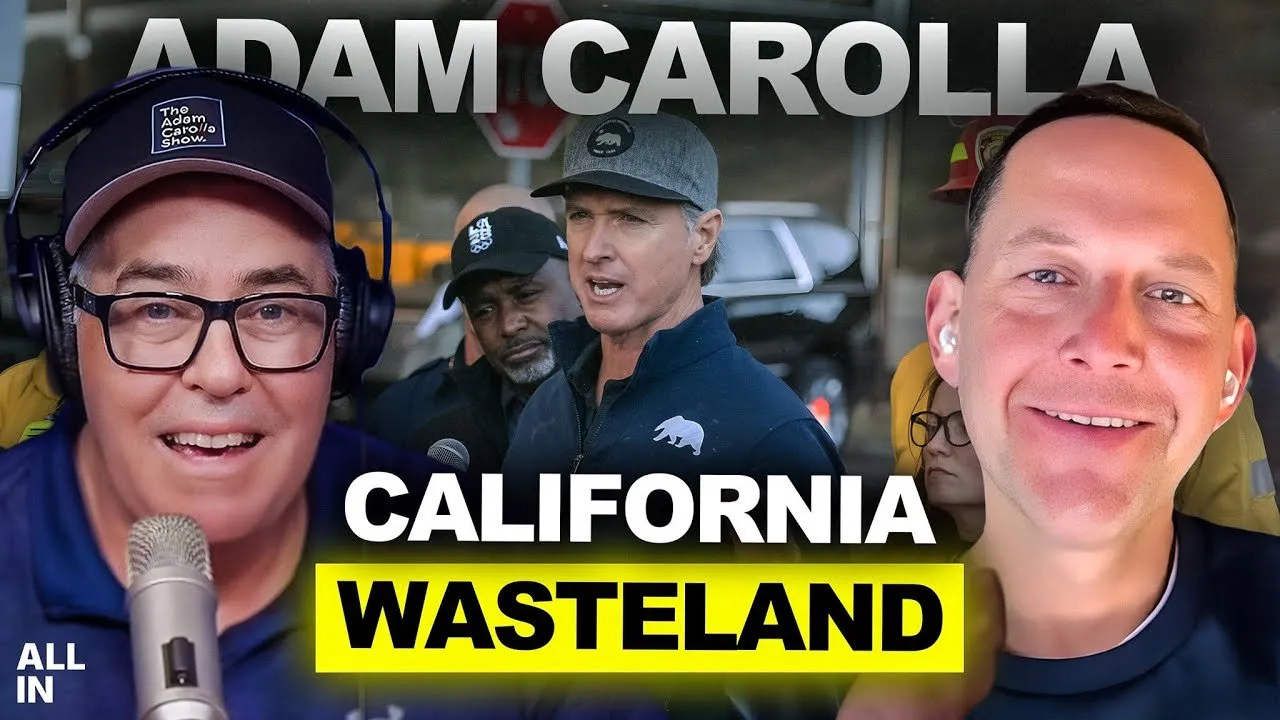
Adam Carolla has evolved from a Loveline icon to one of the most distinct voices in cultural commentary. A licensed contractor turned comedian and podcaster, Carolla brings a unique "blue-collar" perspective to high-level socio-political debates. In a recent detailed discussion, he dissected the current state of California, attributing its decline not to standard corruption, but to a fundamental shift in leadership psychology and regulatory overreach.
From the ashes of the Palisades fire to the exodus of residents toward "red state" havens, Carolla offers a provocative diagnosis of what he terms "gyno-fascism"—a safety-obsessed governance style—and predicts a significant political realignment driven by citizens who simply want to be left alone.
Key Takeaways
- The Paralysis of "Safetyism": Carolla argues that an obsession with safety over practicality (which he terms "gyno-fascism") has ground California’s development and recovery efforts to a halt.
- Bureaucracy vs. Rebuilding: One year after the Palisades fire destroyed nearly 7,000 structures, virtually no rebuilding has occurred due to prohibitive permitting processes rather than construction constraints.
- The "Octagon" Theory: The US is splitting into "Safe Spaces" (highly regulated blue states) and "Octagons" (competitive red states), with Carolla predicting the collapse of the former and the success of the latter.
- Meritocracy in Media: The comedian critiques modern DEI initiatives in Hollywood and journalism, arguing that forced inclusion lowers product quality and creates biased narratives.
- The "Leave Me Alone" Voter: A growing political demographic consists of historically apolitical citizens forced into engagement solely because government overreach has begun to disrupt their daily lives.
The Stagnation of California: A Case Study in Regulation
The conversation anchors on the aftermath of the Palisades Fire. Despite the destruction of 6,837 structures, including roughly 5,000 homes, recovery has been virtually non-existent. Carolla notes that as of November 2025, only one home had been rebuilt. Drawing on his background in construction, he argues that the bottleneck is not a lack of labor, materials, or desire, but a regulatory environment that actively dissuades progress.
The Permitting Quagmire
Carolla contends that the difficulty of building in Los Angeles is a feature, not a bug, of the current administration. He recalls predicting the stagnation immediately after the fire, warning listeners that despite promises of expedited processes, the city's red tape would suffocate rebuilding efforts.
"I literally walked out of the Equinox gym... and I saw smoke. It was nine forty-five in the morning... I said, do not expect any rebuilding. You guys have no idea what the permitting process is... It is not going to happen."
This regulatory burden extends beyond disaster recovery. It affects affordable housing and commercial development, with many franchises refusing to open locations in Los Angeles due to the "cumbersome and expensive" hurdles that effectively scrub projects before they begin.
"Gyno-Fascism" and the Cult of Safety
In perhaps his most controversial diagnosis of the modern political landscape, Carolla introduces the concept of "gyno-fascism." He clarifies that this is not an attack on women, but a critique of a specific leadership style that prioritizes "safety uber alles" (safety above all else) at the expense of functionality and economic health.
The Cost of Absolute Safety
Carolla posits that modern governance, particularly in California, has been taken over by a mindset that seeks to eliminate all risk regardless of the second-order consequences. He draws parallels between this governance style and the response to the COVID-19 pandemic, where schools and businesses were shuttered in the name of safety without adequately weighing the collateral damage to education and the economy.
"They hide behind the shield of safety because it makes them sound noble... But it’s essentially like saying, 'Look, wouldn't your car be safer if it had a full NASCAR style roll cage in it?'... It would be, but you just added 70% to the cost."
This mindset creates a friction that makes governance procedural rather than outcome-oriented. Carolla contrasts the "builder" mentality—which focuses on speed and completion—with the bureaucratic mentality that focuses on process and protection. When these opposing forces meet, as they did during the fire recovery efforts, the result is often paralysis.
Media Bias and the Death of Meritocracy
The shift in leadership psychology is not limited to government; Carolla observes a parallel evolution in media and Hollywood. He argues that newsrooms and creative suites have shifted from merit-based hierarchies to identity-based selections, fundamentally altering the content produced.
The Impact of DEI on Culture
Carolla suggests that diversity mandates in Hollywood, such as the Academy of Motion Picture Arts and Sciences' inclusion rules, damage the final product. He argues that when you limit the talent pool based on race, gender, or sexual orientation rather than skill, the quality inevitably suffers. He likens it to a sports team selecting players based on demographics rather than athletic ability.
"You can't just help people of color without a certain point hurting white males... There is no just helping one group. There has to be a couple of funny middle-aged white guys who aren't employed because you made room for the Latina chicks."
Furthermore, he attributes the media's current bias to an emotional investment in narratives rather than objective reporting. He compares modern journalism to a mother umpiring her own son's baseball game—unable to call "balls and strikes" impartially due to an inherent desire to protect her "team."
The Great Migration: Safe Spaces vs. Octagons
Looking at the broader American landscape, Carolla references a theory he developed with Dr. Drew Pinsky regarding the future of the United States. He predicts a self-segregation of the population into two distinct camps:
- Safe Spaces: States like California, Oregon, and Washington that prioritize regulation, social safety nets, and "nanny state" policies.
- Octagons: States like Texas, Florida, and Tennessee that prioritize competition, deregulation, and individual liberty.
Carolla observes that the "Safe Spaces" are becoming unsustainable. High taxes, homelessness, and permissiveness toward crime are driving productive citizens and businesses toward the "Octagons." He notes that this migration is no longer just about retirement; it is an active flight of families and industries seeking functional governance.
The Economic Breaking Point
While some argue that California can sustain its spending through taxing the wealthy, Carolla warns that the state is treating its most productive citizens as "piggy banks." With proposals for wealth taxes and exit taxes gaining traction, he argues the state is accelerating the very exodus that threatens its solvency.
"You can't just keep looking at people as piggy banks, especially the ones that are creating the jobs... Taking more than 50 percent of your money, I would argue is the ultimate government overreach."
The Rise of the "Leave Me Alone" Voter
As the conversation turned to the future of politics, Carolla identified a growing voting bloc that could decide the next election cycles: the apolitical citizen. These are individuals who have no inherent interest in politics but are being forced into the arena because government policy has begun to intrude on their basic quality of life.
This demographic isn't driven by ideology but by practicality. They are people who want to renovate their homes, drive their preferred vehicles, and ensure their children receive a standard education without ideological indoctrination. When the government prevents them from rebuilding their burnt-down homes or fails to keep their streets safe, they become politically active out of necessity.
Carolla concludes that this sentiment—the desire for a government that performs its basic duties and otherwise steps out of the way—is the unifying force behind the migration to "Octagon" states and the shifting political tides in America.
Conclusion
Adam Carolla’s assessment of California is stark. He describes a state rich in natural resources and capital but impoverished by a leadership class paralyzed by safetyism and identity politics. As high-net-worth individuals and corporations continue to decamp for states with more favorable business climates, California faces a reckoning.
The friction between the "Safe Space" ideology and economic reality is coming to a head. For Carolla, the solution is not more complex regulation, but a return to practical, merit-based leadership that respects property rights and understands that a society cannot function if it prioritizes safety to the point of immobility.