Table of Contents
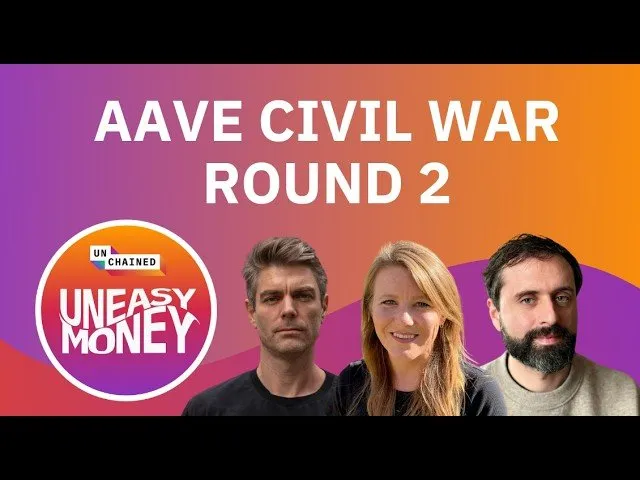
The transition from a group of friends coding in a room to a billion-dollar decentralized protocol is rarely smooth. As DeFi projects mature, the lack of legal clarity that was once a feature becomes a critical bug, leading to high-stakes conflicts over intellectual property, revenue streams, and governance power. Recent events surrounding the Aave protocol, the Infinex token launch, and the explosion of prediction markets like Polymarket have brought these tensions to the forefront. Whether it is a DAO fighting for control of its brand or a founder battling bot farms, the industry is currently undergoing a painful but necessary stress test regarding how value and information are distributed.
Key Takeaways
- The Aave Governance Dispute: A conflict has emerged between Aave DAO and Aave Labs regarding the ownership of brand assets and the redirection of front-end fees, highlighting the need for legal wrappers around DAO intellectual property.
- Capital Formation Challenges: The backlash surrounding the Infinex raise demonstrates that the crypto "timeline" is burnt out and cynical, making it difficult for founders to iterate on distribution models without facing accusations of malice.
- Prediction Market Ethics: The debate over "insider trading" on Polymarket reveals a fundamental misunderstanding among users regarding the purpose of prediction markets, which exist specifically to price in information asymmetry.
- Ethereum’s Credible Neutrality: Despite VC criticism that the Ethereum Foundation isn't building for users, proponents argue that Vitalik Buterin’s focus on "resilience" and neutrality is exactly what allows diverse ecosystems to thrive.
Who Owns the Brand? The Aave DAO vs. Labs Conflict
For years, Aave has been heralded as the gold standard of DAO governance. However, a recent rift between token holders and Aave Labs—the development company led by founder Stani Kulechov—has exposed the fragility of decentralized governance when legal ownership remains ambiguous. The conflict began when Aave Labs switched the swap provider on the Aave front-end from ParaSwap to CowSwap and subsequently redirected approximately eight figures of fee revenue from the DAO treasury to a Labs-controlled multi-sig.
According to Marc Zeller, founder of the Aave Chan Initiative, this move was akin to an executive at Apple suddenly deciding to pocket all App Store fees personally. While the fee switch triggered the conversation, it unveiled a much deeper issue: the ownership of the Aave brand, domain names, and intellectual property.
The Nash Equilibrium of Governance
The core tension lies in the asymmetry of the relationship. While the DAO governs the protocol parameters, Aave Labs controls the entry point—the website aave.com. Zeller argues that without DAO ownership of these strategic assets, the protocol faces an existential risk where a service provider could unilaterally fork the project or redirect users.
"It’s part of becoming an adult... to get the clarity right... We need robust DAO structures."
The proposed solution involves creating a legal entity for the DAO to hold these assets, creating a "Nash Equilibrium" where incentives align. If the DAO owns the IP, it can mandate licenses back to Labs. This ensures that if the relationship breaks down, the DAO has recourse. While the initial proposal to transfer brand assets was voted down, discussions have moved toward a "Phase 2" constructive compromise involving revenue sharing and formalized mandates.
Infinex and the Cynicism of the Trenches
Capital formation in crypto has evolved from ICOs to airdrops, and now to points programs, yet the friction between founders and the community persists. Kane Warwick’s experience with the Infinex launch highlights the extreme cynicism currently permeating the crypto ecosystem. Attempting to avoid the pitfalls of airdrops, Infinex opted for a raise structure that was quickly overrun by bot farms and "AI slop," threatening to dilute genuine community members.
When Warwick altered the terms of the raise to curb this extraction, the backlash was severe. The reaction from the "timeline" reveals a user base that feels repeatedly harvested and is now hyper-sensitive to rule changes, even when those changes are designed to protect the integrity of the raise.
The Game Theory of Fundraising
The incident underscores a "damned if you do, damned if you don't" dynamic. Founders attempting to fix broken incentives in real-time are often accused of "rugging" participants who were playing by the previous rules. The result is an adversarial environment where trust is non-existent.
"The timeline is so cynical, so burnt out, so cooked. Like they feel like so much money has been extracted from them... there is just no belief whatsoever that that's not max extraction."
Warwick admitted that in hindsight, the "fair" move might have been to simply pay out the bots to avoid the reputational hit, despite the negative impact on the project's distribution. This serves as a stark warning for builders: if the game theory of a launch isn't perfect on day one, correcting it mid-flight may cause more damage than the exploit itself.
Redefining Insider Trading for Prediction Markets
The rise of Polymarket has triggered a fierce debate regarding "insider trading," particularly following high-profile bets on geopolitical events like the capture of Venezuelan President Nicolás Maduro. When betting activity spiked hours before the news broke, critics cried foul, conflating the pricing of private information with illegal securities fraud.
However, from a market structure perspective, the purpose of a prediction market is precisely to surface private information. Unlike the stock market, where laws exist to prevent insiders from stealing value from their own shareholders, a prediction market is designed to ingest all available data to form an accurate probability.
Information Asymmetry vs. Fairness
There is a distinct clash between the economic theory of efficient markets and the average user's sense of fairness. Taylor Monahan points out that for mainstream adoption, the perception of a "rigged game" is detrimental. If users believe they are essentially liquidity for government insiders or corporate executives, they will exit the market.
Conversely, the counter-argument is that participating in a prediction market without an information edge is functionally gambling. If a trader takes a position on a geopolitical outcome against someone with better intelligence, they are providing the liquidity that makes the market accurate.
"If you're participating in a prediction market and you're like, 'no, no, no, someone can't know information that I don't know'... That is literally the entire point."
The consensus is that while corporate policies and employment contracts may forbid employees from betting on their own output, applying securities laws to binary outcome markets is a category error. The solution likely lies in clearer education: users need to understand they are not betting on sports, but trading against the collective intelligence of the world.
Ethereum’s Credible Neutrality
The discussion concluded with a look at the philosophical divide between Ethereum’s roadmap and its venture capital critics. Kyle Samani of Multicoin Capital recently criticized the Ethereum Foundation (EF), arguing that Vitalik Buterin is building for his own theoretical ideals rather than for what users actually want. This critique centers on the EF's refusal to "pick winners" in the way ecosystems like Solana or Base might.
However, the concept of "credible neutrality" remains Ethereum's strongest defensive moat. By refusing to anoint specific DeFi protocols or business models, the EF creates an environment where anyone can build without fear of being de-platformed or competing against the chain itself. While this approach may seem slower or less coordinated than centralized alternatives, it fosters the "resilience" that Vitalik champions—a quality that becomes invaluable when regulatory or systemic pressures mount.
Conclusion
Whether it is Aave defining its corporate structure, Infinex navigating token distribution, or Polymarket defending the utility of asymmetric information, the crypto industry is currently wrestling with the growing pains of legitimacy. The "friends in a room" era is over. To survive the next cycle, protocols must establish robust legal wrappers, clear governance mandates, and economic models that can withstand both adversarial attacks and regulatory scrutiny.