Table of Contents
Most people treat a side hustle as a way to generate a little extra pocket money. But the right idea, executed with the right strategy, isn't just a side gig—it is a scalable startup waiting to happen. The difference between a few hundred dollars a month and an eight-figure exit often lies in market selection and distribution.
In this deep dive, Chris Kerner—known for his "saucy" takes on business—breaks down opportunities that have low barriers to entry but massive ceilings. These aren't just theoretical concepts; they are gaps in the market where demand currently outstrips supply, ranging from software solutions for massive platforms to physical products that leverage viral algorithms.
Whether you are a developer looking for a SaaS idea or an operator ready to get your hands dirty, the goal here is simple: stop sitting on ideas and start building cash flow.
Key Takeaways
- The Facebook Marketplace Gap: Despite having 500 million users, Facebook Marketplace lacks the third-party software ecosystem that eBay and Shopify have, creating a massive opportunity for developers.
- Distribution Over Product: You can build a business around "dumb" products if you master short-form video and leverage algorithmic engagement (even outrage).
- Service-Based Recurring Revenue: Niche services like mobile bike washing or safety stickers for bars can be transformed into high-margin subscription businesses.
- The "Lame" Asset Strategy: There is significant upside in cornering the market on overlooked alternative assets, such as specific vintage Pokémon cards, rather than chasing blue-chip items.
- Disrupting Legacy Gatekeepers: Industries like sports card grading are ripe for disruption through AI and speed, challenging slow incumbents like PSA.
The Untapped Goldmine of Facebook Marketplace
Facebook Marketplace is one of the most trafficked e-commerce platforms in existence. Approximately 16% of Facebook's 3 billion monthly active users log in solely to shop. That is half a billion people. Yet, the ecosystem surrounding it is surprisingly barren.
If you look at eBay or Shopify, there are thousands of third-party applications designed to help sellers. These tools assist with analytics, cross-listing, price alerts, and arbitrage scanning. Developers have built billion-dollar ecosystems on top of Shopify. In contrast, Facebook Marketplace has almost no legitimate third-party software support.
The SaaS Opportunity
There is a prevailing myth that the Facebook API permissions do not allow for these types of tools. This is largely incorrect. While there are restrictions, compliant ways to build tools that scan items, provide price alerts, or help power-sellers manage inventory exist.
Currently, sellers are operating "in the shadows," using "vibe-coded" scripts and janky internal tools to find arbitrage opportunities. If you can build a polished, compliant SaaS product that gives flippers and power-sellers an edge, you have a captive audience willing to pay.
First time founders focus on product. Second time founders focus on distribution.
Weaponizing "Dumb" Products with Viral Video
In the current era of social media, distribution often matters more than the utility of the product itself. The algorithm rewards engagement, and nothing drives engagement quite like polarization. This creates a unique business model: manufacturing simple, 3D-printable products and using short-form video to sell them.
The "AI Hate" Marketing Strategy
A fascinating nuance in modern marketing is the visceral reaction people have toward Artificial Intelligence. You can leverage this by creating physical products that integrate AI in seemingly pointless ways—like a voice-enabled boat propeller guard.
When you post a video of this "dumb" product, half the audience will comment on how stupid it is, while the other half sees the utility. The algorithm doesn't care about the sentiment; it only cares about the comment volume. This drives massive organic reach, putting your product in front of the small percentage of buyers who actually want it.
The roadmap here is straightforward:
- Use AI to brainstorm simple hardware solutions.
- 3D print a prototype.
- Film a short-form video demonstrating it.
- Launch a pre-order page to validate demand before investing in manufacturing.
Scaling Niche Services
Service businesses are often dismissed as unscalable, but if you target the right demographic with the right recurring revenue model, they can become cash cows. The key is identifying customers with high disposable income and a pain point that requires regular maintenance.
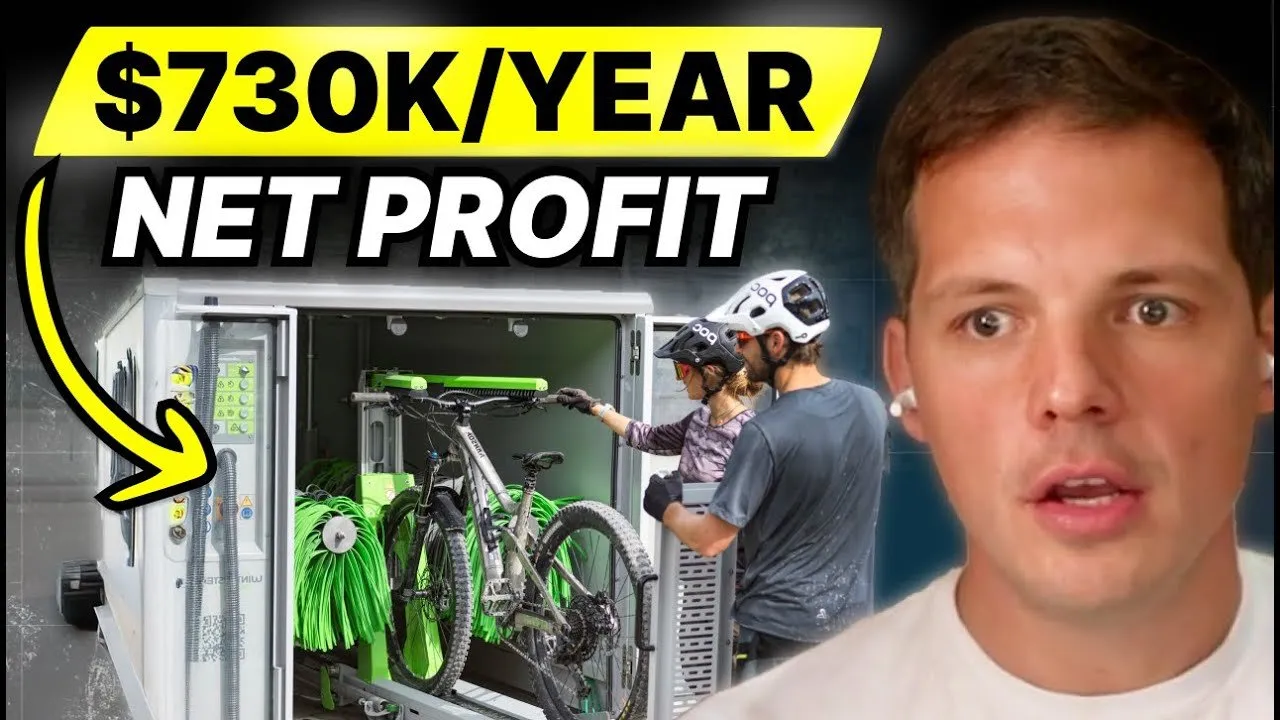
The Mobile Bike Wash
Cycling has exploded in popularity, with enthusiasts regularly spending $5,000 to $15,000 on high-end road and mountain bikes. However, maintaining these bikes is a hassle, especially for people living in apartments without access to hoses and outdoor space.
A mobile bike wash stationed at popular trailheads or coffee stops solves this immediately. By charging $20 for a wash and dry while the cyclist grabs a coffee, you create frictionless revenue. To scale this beyond a "time-for-money" trap, you move to a subscription model (e.g., $30/month for unlimited washes). This mirrors the car wash industry, where breakage—people paying for subscriptions they don't use—drives high margins.
Safety as a Service: Drink Spiking Stickers
Another area ripe for innovation is safety. Drink spiking is a major concern at bars and clubs. A simple solution exists: disposable, anti-spike stickers that seal over a drink.
The business model here is B2B sales to venues. You sell rolls of these stickers to bars, potentially customizing them with the bar's logo or a QR code. The bar gets to market itself as the "safest spot in town," and you establish a recurring consumable product line. Because the product is viral by nature—patrons post photos of their safe drinks on Instagram—the customers handle the marketing for you.
The "Kabuto King" Asset Strategy
When people think of investing in collectibles like Pokémon cards, they usually think of high-ticket items like a Charizard. However, there is a counter-intuitive strategy that relies on volume and cornering the market on "lame" assets.
This is known as the "Kabuto King" strategy. An investor identifies a vintage, first-edition card of a less popular character (like Kabuto or Krabby) and quietly buys every single available copy on the market. These cards might trade for pennies initially.
Why It Works
This is a supply and demand play. The supply of 1999 first-edition cards is finite; they aren't printing any more. by absorbing the supply, you control the market floor. Furthermore, meme culture drives value. By turning a specific "lame" card into a movement or a meme on social media, you can drive interest and liquidity.
A lot of people want the full set. First edition, all 152 cards from 1999... How are they going to get that? They got to go through you.
While this requires capital to execute at scale (potentially hundreds of thousands to corner a market completely), it can be started with smaller amounts by targeting overlooked niches. The end game is becoming the primary supplier for serious collectors who need your specific card to complete their vintage sets.
Disrupting the Grading Industry
The trading card boom has exposed a massive bottleneck: grading. The incumbent, PSA, is slow, expensive, and archaic. It can cost $50 and take weeks or months to get a card graded. This friction creates an opening for a "David vs. Goliath" disruption.
A modern competitor could differentiate through:
- Speed and Technology: Using AI to pre-grade cards via photos before shipping, reducing the risk for the customer.
- Cost: Offering a $5 grading service to undercut the market.
- Transparency: Live-streaming the grading process to build trust and entertainment value.
- Visual Appeal: Creating better, more distinct packaging ("slabs") that look premium compared to the sterile industry standard.
By positioning a new service as the "people's grader"—transparent, fast, and affordable—you can attack the 80/20 of the market. You don't need to beat PSA on high-end million-dollar cards immediately; you just need to capture the volume of mid-tier collectors who want their cards slabbed without waiting three months.
Conclusion
The common thread across all these ideas is that they take existing behaviors—shopping on Facebook, riding bikes, collecting cards—and remove friction or add a layer of scalability. Whether you are building software or selling stickers, the goal is to move from a passive idea to active execution.
As Chris Kerner notes, statistically, the first idea you have is rarely the best one. However, you will never find the winning idea if you don't start executing on the first one. Pick a lane, validate the demand, and start building.