Table of Contents
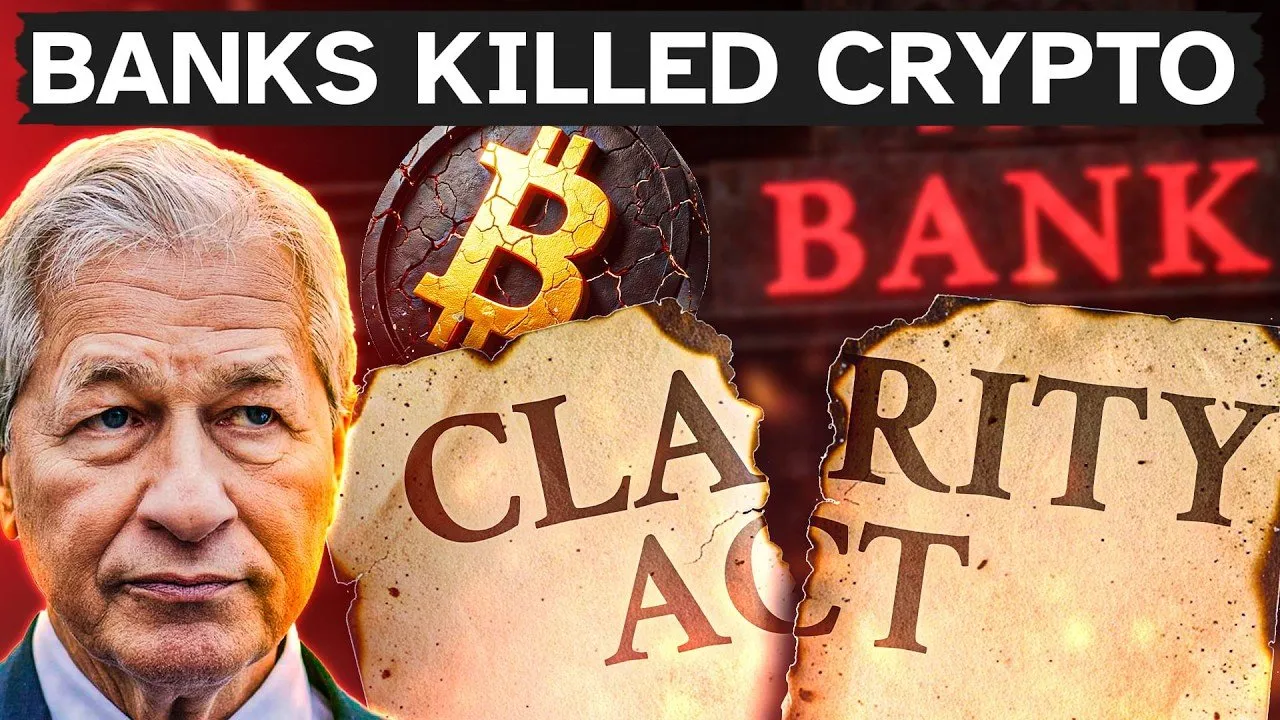
The "Digital Asset Market Clarity Act," a legislative framework anticipated to stabilize the United States cryptocurrency market, collapsed in the Senate this week following the abrupt withdrawal of support from key industry leaders. While the bill’s failure was publicly attributed to procedural disagreements, new analysis suggests the legislation was derailed by a last-minute provision lobbied for by the traditional banking sector. At the heart of the conflict is a projected $6.6 trillion migration of capital from commercial bank deposits to yield-bearing stablecoins, a shift that major financial institutions fear could destabilize their business models.
Key Takeaways
- Legislative Collapse: The Clarity Act failed to reach markup after a controversial provision banning "passive yield" on stablecoins was inserted into the text.
- The $6.6 Trillion Threat: Banking executives fear that up to 35% of U.S. deposits could flee to stablecoins if digital asset providers are permitted to pass treasury yields directly to consumers.
- The Yield Gap: The dispute centers on the margin between the near-zero interest banks pay on deposits and the roughly 3.6% they earn on government debt—a profit center stablecoins threaten to disrupt.
- Global Divergence: While the U.S. moves to restrict yields on digital assets, China’s central bank has begun offering interest on the digital yuan to spur adoption.
The 'Poison Pill' Provision
The Clarity Act, championed by Senate Banking Committee Chairman Tim Scott, was poised for bipartisan support until a revised draft circulated on January 12. The new text included a specific prohibition preventing digital asset providers from paying interest or yield "simply for changing stablecoins." This clause effectively sought to outlaw the passive income models that have made stablecoins an attractive alternative to traditional savings accounts.
The inclusion of this language prompted immediate backlash from the crypto industry. On January 14, Coinbase CEO Brian Armstrong publicly withdrew his company’s support for the bill, creating a political impasse that forced the indefinite postponement of the committee markup.
"It just felt deeply unfair to me that one industry would come in and get to do regulatory capture to ban their competition. It is a kill switch for stablecoin rewards." — Brian Armstrong, CEO of Coinbase
The Economics of the Conflict
The intensity of the lobbying effort against stablecoin yields is rooted in the fundamental mechanics of commercial banking. Currently, the national average interest rate for a standard U.S. savings account sits at approximately 0.39%, with checking accounts offering a negligible 0.07%. Conversely, short-term U.S. Treasury bills—where banks park much of this customer capital—are yielding approximately 3.6%.
The Arbitrage Threat
This spread represents a critical revenue stream for traditional banks. Financial institutions utilize customer deposits to purchase risk-free government debt, pocketing the roughly 3.5% difference. Stablecoin issuers, such as Circle or platforms like Coinbase, threaten this model by holding the same U.S. Treasuries as reserves but passing the majority of the yield directly to the user.
In a finalized regulatory environment, consumers would face a binary choice: hold digital dollars in a bank account earning 0.07%, or hold the same digital dollars on-chain earning nearly 4%. The banking sector’s internal modeling suggests the outcome of such a choice would be catastrophic for their liquidity.
The Nightmare Scenario for Banks
During a recent Q4 earnings call, Bank of America CEO Brian Moynihan referenced Treasury Department studies indicating the potential scale of this capital flight. Estimates suggest that if stablecoins were permitted to freely offer yield, approximately $6 trillion to $6.6 trillion in deposits could leave the banking system. Given that total U.S. commercial bank deposits hover around $18.6 trillion, this represents an exodus of over 30% of the industry's deposit base.
Lobbyists argue that this capital flight would trigger severe macroeconomic consequences. Data from the Federal Reserve suggests a multiplier effect on bank deposits; for every $100 billion that leaves the system, lending contracts by anywhere from $60 billion to $126 billion. The banking lobby contends that a $6 trillion outflow would force a massive contraction in credit availability for mortgages, small businesses, and agricultural loans.
Global Competitiveness Risks
While U.S. regulators debate the legality of digital yield, international competitors are actively integrating it into their monetary policy. As of January 1, 2026, the People's Bank of China reclassified the digital yuan (e-CNY) as "digital deposit currency," offering a 0.05% interest rate to holders. While the rate is nominal, the structural shift signals China’s intent to make its central bank digital currency (CBDC) a superior product to physical cash.
Industry experts warn that the U.S. stance creates a disadvantage for the dollar in the global digital economy. If foreign stablecoins or CBDCs offer automatic yield while U.S. regulated stablecoins are prohibited from doing so, global capital may flow toward the assets that offer better returns.
"The banks do not want the competition, so they're blocking the yield. In the meantime, the Chinese are issuing yield. So, what do you think the emerging countries will choose?" — Anthony Scaramucci
What Comes Next
With the Clarity Act stalled, the market faces a period of regulatory limbo. The industry is now likely to fracture into three potential paths. First, issuers may seek to operate offshore, offering "wrapped" products that legally circumvent U.S. banking restrictions while still delivering yield to users. Second, a new legislative compromise may emerge that permits "activity-based" rewards—such as staking or transaction incentives—rather than passive yield, mirroring the credit card rewards model.
However, the most pressing reality for the banking sector is that technological efficiency is difficult to legislate away. With tokenized treasuries already gaining traction on-chain, the disparity between traditional bank interest and market rates remains a persistent driver for innovation. Whether through regulation or decentralized protocols, the pressure to unlock the risk-free rate for the average consumer will continue to challenge the traditional banking monopoly.