
Table of Contents
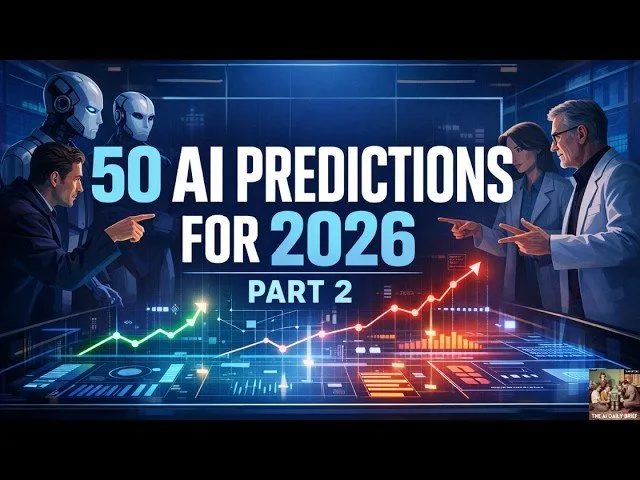
As the artificial intelligence sector accelerates toward 2026, industry analysis forecasts a pivotal year defined by entrenched competitive moats, significant market recalibrations, and growing political friction regarding infrastructure. New predictions suggest that while consumer adoption for platforms like ChatGPT and Gemini will likely surpass one billion users, the leading laboratories will face intensifying pressure regarding monetization strategies, infrastructure financing, and public sentiment.
Key Points
- Anthropic is expected to retain its dominance in coding capabilities, with Microsoft potentially expanding its partnership to integrate these tools into enterprise suites.
- OpenAI faces challenges regarding focus and revenue, making the introduction of advertising within ChatGPT a near certainty.
- Alphabet is predicted to become the world’s most valuable company in 2026, driven by the growth of Gemini and its custom TPU silicon.
- Political backlash against data centers is projected to rise, with resource consumption and "AI layoffs" becoming populist campaign issues.
- IPO Activity for major labs like OpenAI and Anthropic is expected to remain stalled until 2027, barring unforeseen capital urgency.
Deepening Moats and Monetization Pressures
The competitive landscape in 2026 will likely be characterized by specialized dominance rather than a single winner-takes-all model. According to the analysis, Anthropic has secured a commanding lead in coding workflows that will be difficult for competitors to disrupt. This "stickiness" among developers suggests that even if rival models achieve benchmark parity, the switching costs for enterprise users will remain prohibitively high. Consequently, Microsoft is predicted to seek a deeper integration of Anthropic’s coding tools, potentially creating a complex dual-strategy alongside its OpenAI partnership.
For OpenAI, the path forward involves navigating internal resource fragmentation between consumer products, enterprise solutions, and fundamental AGI research. To bridge the gap between high infrastructure costs and revenue targets, the introduction of an advertising model appears inevitable.
"I just believe that it's inevitable that ads will come to ChatGPT... It's just a really good medium for advertising. I think OpenAI is going to continue to face questions in the market as to whether they can actually reach their heady revenue targets."
Meanwhile, Alphabet is positioned to capitalize on its vertical integration. If the current trajectory of Gemini’s growth and Google Cloud’s expansion holds, combined with the external sales of TPUs, Alphabet could surpass its peers to claim the top market capitalization spot globally.
Market Shifts and M&A Activity
Financial markets are expected to undergo a "reality check" regarding AI infrastructure. While hyperscalers have historically funded build-outs from their own balance sheets, the burden is shifting toward private credit. The analysis warns that markets will be "extremely on edge" regarding any instability in data center financing. Despite these risks, the sheer capital requirements of the sector suggest that major IPOs for OpenAI or Anthropic will likely be pushed to 2027, as companies opt to remain private to avoid public market volatility.
Mergers and acquisitions are predicted to accelerate, specifically focusing on "Agent Labs"—companies building autonomous code and task agents. Large tech incumbents, particularly Microsoft, are expected to acquire high-performing agent startups to bolster their internal capabilities before they become formidable independent competitors.
The Politicization of AI Infrastructure
Beyond the technical and financial spheres, 2026 is poised to be the year AI becomes a distinct political wedge issue. The narrative is expected to shift from abstract fears of superintelligence to tangible economic concerns. Data centers, which require massive amounts of power and water, are predicted to become targets for populist rhetoric on both sides of the political aisle.
Furthermore, the analysis suggests a rise in "artisanal anti-AI" sentiment, where "human-made" becomes a luxury classification similar to organic labels in food. This cultural shift will likely run parallel to heightened political scrutiny over employment.
"The anti-AI narrative writes itself. The robots are taking your jobs, your energy, drinking your water, and raising your power bill... Pretty much all layoffs in 2026 are going to be attributed to AI."
As the 2026 midterms approach, these tensions will likely result in a fragmented policy landscape, with individual states passing divergent regulations in the absence of comprehensive federal legislation. This regulatory patchwork may finally push major AI labs to lobby for national standards to ensure operational consistency.
![Trump Market Manipulation Will Trap You! [This Happens Next]](/content/images/size/w1304/format/webp/2026/03/trump-market-manipulation-volatility-warning.jpg)
