Table of Contents
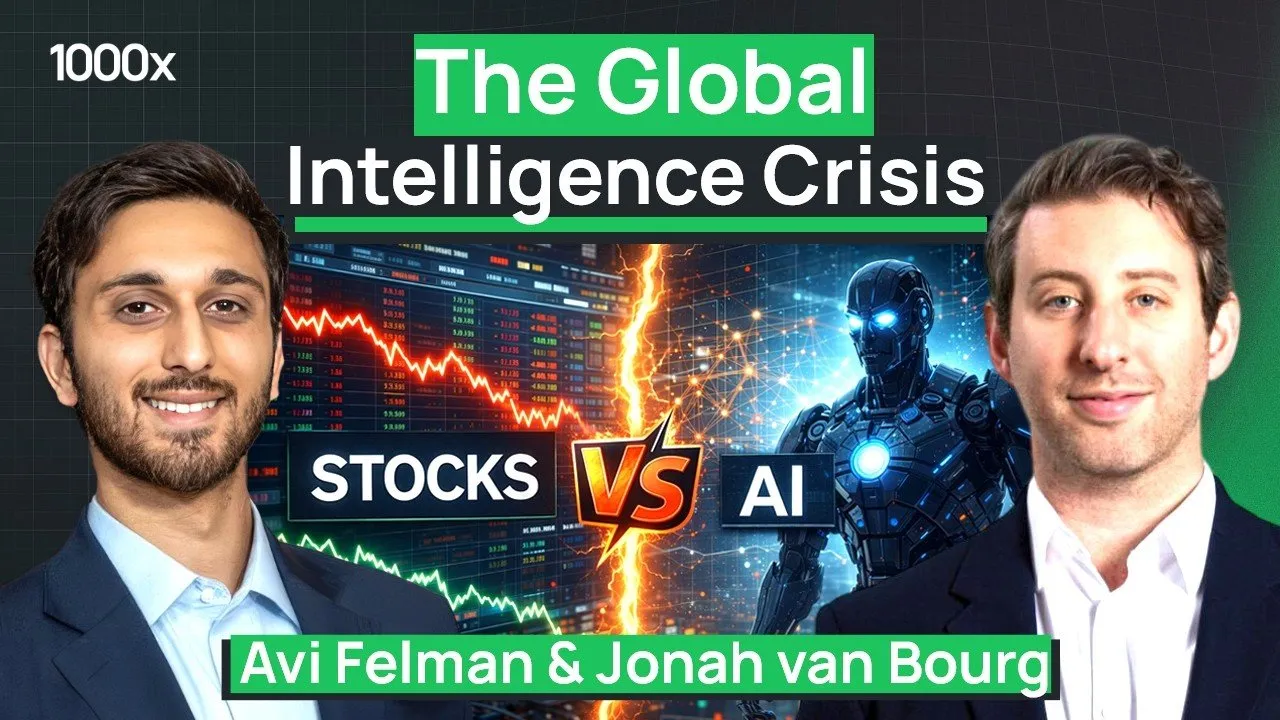
The financial world has recently been set ablaze by a provocative thesis suggesting that the very technology promised to usher in a new era of prosperity—Artificial Intelligence—might instead trigger a systemic economic collapse by 2028. This "intelligence crisis," popularized by recent viral research from Citrini, argues that the rapid removal of economic friction will decimate the service-based U.S. economy. As the debate between "AI doomers" and tech-optimists intensifies, investors are left questioning whether we are witnessing a revolutionary economic panacea or a deflationary pandemic that will leave white-collar professionals permanently displaced.
Key Takeaways
- The Frictionless Collapse: Trillions of dollars in enterprise value currently rely on human limitations and "friction." AI agents that can shop for the best prices and automate complex tasks threaten to destroy these profit moats.
- A New Credit Crisis: Unlike the 2008 subprime crisis, the 2028 scenario suggests a "prime borrower" default wave as high-earning SaaS and white-collar workers see their incomes plummet.
- Monetary Intervention: In a deflationary spiral, the Federal Reserve is expected to return to "zero-rate" policies and "helicopter money," potentially making Bitcoin and gold the ultimate passive hedges.
- Strategic Sector Shifting: Survival in this market requires moving away from human-output businesses (like legacy consulting) and toward energy, nuclear power, and "edge" computing.
The End of Friction: How AI Targets the Service Economy
For decades, the United States has functioned primarily as a service economy. This structure relies on a fundamental concept: friction. We pay premiums to real estate agents, interchange fees to credit card companies, and marked-up prices on delivery apps because of human limitations in time, patience, and information access. The Citrini thesis argues that this "rent extraction layer" is about to vanish.
The Disappearance of Corporate Moats
Consider the value proposition of a platform like DoorDash or Uber. Much of their dominance is built on brand familiarity and the friction involved in switching services. When AI agents begin to navigate these marketplaces on behalf of the consumer, they will ignore brand loyalty in favor of pure cost efficiency. If an agent can query sixty different local delivery services in milliseconds to find the lowest price, the "moats" protecting major tech platforms evaporate instantly.
The White-Collar Displacement
The impact extends into high-level professional services. In the current economy, a company might spend $100 million on a mix of people and technology. As AI capabilities expand, that ratio shifts aggressively. If a single GPU cluster in North Dakota can replicate the output of 10,000 white-collar workers, the velocity of money in the human-centric consumer economy—which represents 70% of GDP—could flatline.
"We probably could have figured this out sooner if we just asked how much money machines spend on discretionary goods. Hint: it's zero."
The Prime Borrower Crisis: A 2028 Debt Spiral
One of the most concerning aspects of the intelligence crisis is its potential to trigger a housing and credit meltdown. The 2008 financial crisis was defined by subprime borrowers who could not afford their homes from day one. The 2028 crisis, however, could be driven by prime creditors—professionals with 780 credit scores and $500,000 salaries—who suddenly find their roles automated.
When a SaaS executive earning half a million dollars is replaced by an agentic workflow, they may be forced into the gig economy, seeing their income drop by 90%. While they are still "employed," they can no longer service a premium mortgage. This leads to a systemic unraveling where the housing market collapses not because of bad loans, but because of a sudden, permanent reduction in the value of human intellect.
The Counter-Argument: Historical Resilience and Deflationary Benefits
Critics of the "doomer" narrative argue that this is merely a modern iteration of the Luddite fallacy. Historically, technological breakthroughs—from the Industrial Revolution to the invention of the automobile—have been met with fears of mass unemployment that never fully materialized. Instead, the economy evolved, creating new sectors that were previously unimaginable.
The Reallocation of Capital
If AI significantly reduces the cost of real estate transactions or legal fees, that saved capital does not simply vanish. Homebuyers who save 5% on commissions are likely to spend that money on home improvements, furniture, or other consumer goods. This suggests that while specific sectors will suffer, the overall economy may experience a massive boost in purchasing power as the cost of living deflates.
The Bottleneck Theory
While AI may bust open the current bottleneck of human intelligence, new bottlenecks will inevitably emerge. Whether it is physical energy, specialized hardware, or the ability to utilize AI more effectively than a competitor, the "stabilizing cycle of capitalism" has a track record of finding a new equilibrium. The debate rests on whether humans can adapt at the same speed at which code can iterate.
Market Strategies: How to Trade the Intelligence Crisis
Whether one believes in the "doom loop" or the "economic panacea," both sides agree on certain inevitabilities: massive volatility and a fundamental shift in where value is stored. This environment creates distinct opportunities for the nimble investor.
Long Energy and Physical Constraints
AI growth is currently hitting a physical wall: the power grid. Data centers require immense amounts of electricity, making energy companies and utilities prime beneficiaries. Specifically, uranium and nuclear power are seeing a resurgence as the only viable ways to meet the baseload power requirements of a global AI infrastructure.
Edge Computing and Luxury Tech
As computation moves from centralized data centers to "the edge," devices in our pockets will become more valuable. Companies like Apple are positioned to benefit as the primary interface for consumer AI agents. While the market may sell off tech stocks in a general panic, those with a longer time horizon may find "blue chip" opportunities in firms that own the hardware layer.
Shorting Human Output
Conversely, businesses that primarily sell human labor—such as legacy consulting firms or outsourced IT services—are increasingly viewed as "short" positions. If a company's business model relies on charging high hourly rates for tasks that an LLM can now perform in seconds, their margins are in terminal decline.
"The U.S. Treasury and the Federal Reserve will gang up and start blasting money into the economy with a fire hose to prevent Rome from burning."
Conclusion: Navigating a Period of Radical Change
The 2028 Global Intelligence Crisis may not lead to the end of the world, but it will almost certainly lead to the end of the status quo. We are entering a period of extreme volatility where the timeline for market shifts has compressed from years to months. As hedge funds scramble to front-run these narratives, retail traders have a unique advantage: the ability to remain nimble and choose positions that are "anti-fragile."
Ultimately, the best hedge against the uncertainty of the AI era is to stay invested in assets that benefit from volatility—such as Bitcoin and long-volatility strategies—while maintaining a skeptical eye on legacy institutions that refuse to adapt. The economy will figure it out, but as history shows, the transition is rarely smooth for those standing in the way of progress.