Table of Contents
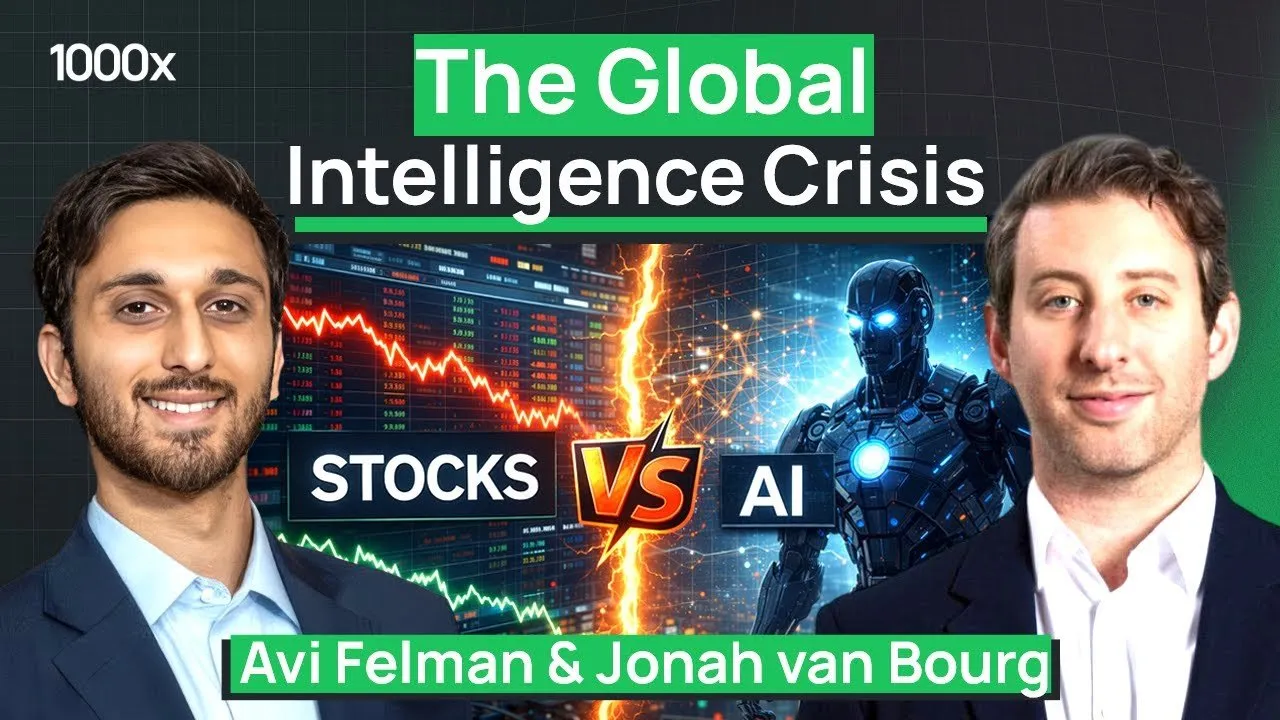
The financial world is currently reeling from a provocative thesis that has sent shockwaves through Silicon Valley and Wall Street alike. A viral research piece, often referred to as the "Catrini article," paints a harrowing picture of the year 2028: a global intelligence crisis where the rapid advancement of AI agents triggers a systemic market crash. The core argument suggests that our modern economy is built on a foundation of human friction—annoyances, delays, and brand loyalty—that AI is designed to eliminate. When that friction vanishes, the trillions of dollars in enterprise value dependent on it may vanish as well.
Key Takeaways
- The Friction Economy: A significant portion of the U.S. service economy relies on "rent extraction" from human limitations; AI agents threaten to compress these margins to near zero.
- The Credit Crisis 2.0: Unlike 2008’s subprime crisis, the next collapse could be driven by "prime" borrowers—high-earning white-collar professionals—losing their income to automation.
- The Monetary Response: To combat AI-driven deflation, the Federal Reserve and Treasury will likely resort to "helicopter money" and zero-interest rates, creating massive volatility.
- Strategic Pivots: Long-term winners likely include "edge" computing giants like Apple and the energy sector (Uranium and Utilities) required to power the AI revolution.
The Catrini Thesis: An Economic Pandemic
The central premise of the current "doomer" narrative is that AI is not merely a tool for productivity but an "economic pandemic." For decades, the U.S. has transitioned into a service-oriented economy where value is often derived from helping consumers overcome friction. Whether it is a real estate agent navigating a complex database or a software company charging a premium for a user-friendly interface, these "moats" are built on the fact that humans have limited time and patience.
AI agents change this equation by acting as perfectly rational, tireless intermediaries. If an agent can instantly scan every available marketplace to find the absolute lowest price for a service, brand loyalty and marketing moats disappear. Companies like DoorDash or Uber, which rely on being the "default" app on a home screen, could see their pricing power evaporate as agents choose the cheapest backend provider every time.
"A single GPU cluster in North Dakota generating the output previously attributed to 10,000 white-collar workers in Midtown Manhattan is more economic pandemic than economic panacea."
The Death of White-Collar Security
The most chilling aspect of this forecast is the predicted impact on the labor market. We are seeing the beginning of what some call the "SAS Apocalypse." High-level software-as-a-service (SaaS) employees earning between $150,000 and $500,000 a year are increasingly vulnerable. As AI takes over coding, middle management, and administrative tasks, these "prime" earners may find themselves displaced.
From High-Tech to Gig Work
The transition for these workers is rarely seamless. The theory suggests that a displaced SaaS engineer doesn't immediately find another high-paying role; instead, they move into the "physical" economy, perhaps driving for a ride-share service or performing manual labor. This creates a massive downward pressure on wages across all sectors. When a 780-credit-score professional loses a half-million-dollar salary, they don't just stop buying luxury goods—they default on their mortgage. This is how a tech disruption turns into a systemic credit crisis.
The Problem with the "Entrepreneur" Rebuttal
Critics of the doomer narrative argue that displaced workers will simply use AI to start their own businesses. However, this contains a significant logical flaw. If it becomes 80% cheaper to start a business, the competition becomes 80% fiercer. Not every former middle manager can become a successful solo entrepreneur. While AI removes the bottleneck of intelligence, it creates a new bottleneck of attention and distribution. Simply put, nobody is going to buy a billion different "passion project" products just because they were easy to make.
The Deflationary Spiral and the Policy Response
AI is fundamentally deflationary. It makes goods and services cheaper by removing the cost of human intellect. While lower prices sound beneficial, they are catastrophic for a debt-based economy. If your salary deflates faster than your fixed mortgage payments, the system breaks. Historically, the U.S. government has shown exactly how it handles such threats: by printing money.
The moment deflationary prints hit the tape, the Federal Reserve will likely move rates back to zero. We should expect a "firehose" of liquidity aimed at stabilizing the housing market and preventing a total collapse of the banking system. For investors, this means the future isn't just about AI growth; it is about the volatility created by the government's attempts to manage the fallout. Assets that are "anti-fragile"—those that benefit from chaos or debasement—will become the ultimate hedges.
Strategic Trading: Where to Position Capital
In a world of radical change, traditional "buy and hold" strategies for human-output businesses are becoming risky. Investors must distinguish between companies that provide the "means of production" for AI and those that are merely "rent-seekers" on human inefficiency.
The Bull Case for Apple and "Edge" Compute
While data centers are the current focus, the future of AI likely lies at "the edge." As users demand more privacy and lower latency, AI models will run locally on devices. Apple stands as the prime beneficiary of this trend. They own the most valuable real estate in the world: the consumer's pocket. If every person on earth begins consuming hundreds of thousands of AI tokens a day, the hardware required to run those models becomes the new essential utility.
Energy: The Physical Constraint
AI is not just code; it is electricity and silicon. There is a massive physical constraint on how fast AI can grow, primarily driven by energy availability. This makes Uranium and Utility companies incredibly attractive. Data centers require massive, consistent power loads that "green" energy alone cannot currently provide. Nuclear energy is the logical conclusion to this demand, making uranium a long-term play on the "intelligence" build-out.
Shorting Human Output
On the flip side, companies that act as "human-heavy" consultants are in the crosshairs. Traditional firms that charge high fees for manual code modernization or middle-management consulting are seeing their business models dismantled. For example, legacy tech giants that rely on massive consulting arms may struggle to justify their margins when AI can perform the same "modernization" tasks in seconds for a fraction of the cost.
"We probably could have figured this out sooner if we just asked how much money machines spend on discretionary goods. Hint: it’s zero."
Conclusion
The 2028 intelligence crisis is not a certainty, but the signals are too strong to ignore. We are moving from an era of smooth, predictable growth into a period of extreme volatility. The "friction" that once protected our jobs and our markets is being sanded down by silicon. Whether this leads to a "melt-up" or a total crash depends on how quickly the labor market can adapt and how aggressively the government intervenes. For the savvy trader, this is not a time to panic, but a time to be hyper-aware. The advantage in this new economy goes to those who can pivot faster than a hedge fund and see the physical constraints behind the digital magic.