Table of Contents
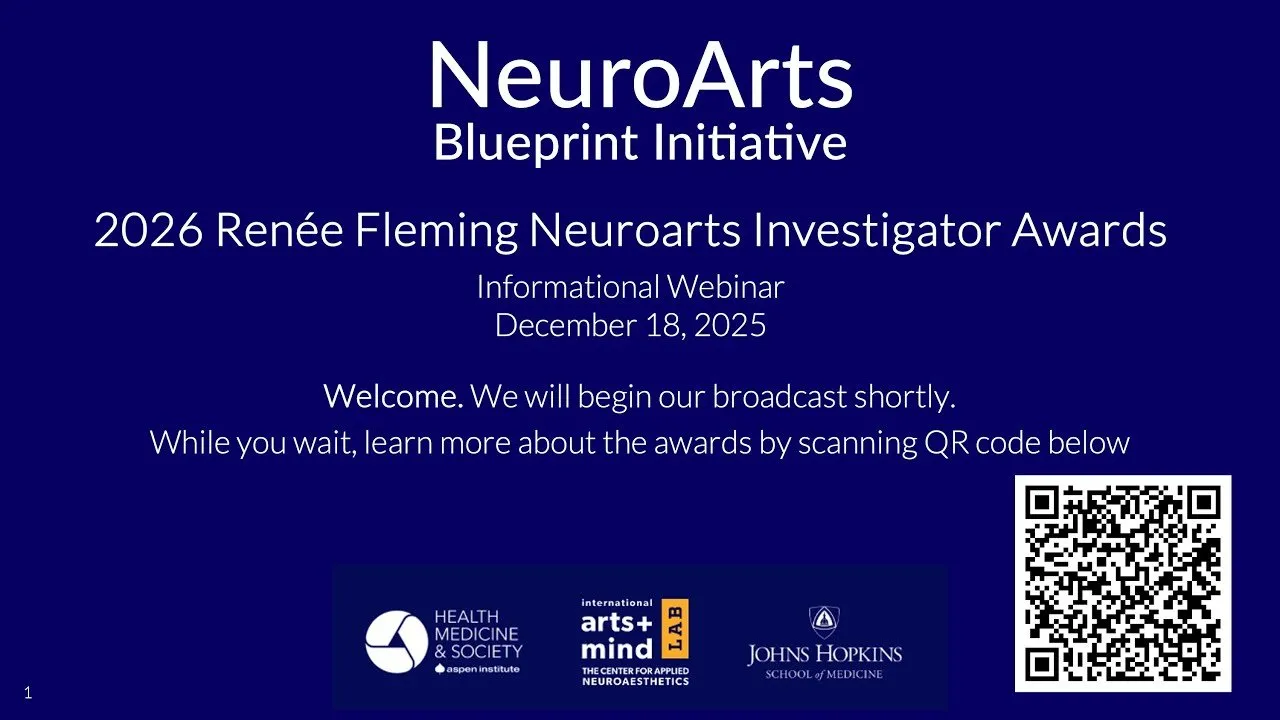
The field of neuroarts is rapidly transitioning from a niche area of study into a mainstream component of public health and medicine. At the forefront of this evolution is the NeuroArts Blueprint Initiative, a partnership between Johns Hopkins University and the Aspen Institute. To accelerate the evidence base for how aesthetic experiences impact the brain and body, the initiative has opened applications for the 2026 Renée Fleming Neuroarts Investigator Awards. This competitive program offers seed funding to support collaborative projects between early-career researchers and artists.
Designed to catalyze innovation, these awards encourage interdisciplinary teams to explore the measurable effects of the arts on health and well-being. Below is a comprehensive guide to the application process, eligibility requirements, and strategic goals of the program based on the recent informational webinar led by Director Susan Magsamen, Renée Fleming, and Dr. Emmeline Edwards.
Key Takeaways
- Award Amount: Grants of up to $25,000 will be awarded to up to 10 project teams.
- Core Requirement: Each proposal must be co-led by two Principal Investigators (Co-PIs): one early-career scientist and one arts practitioner.
- Application Deadline: Proposals must be submitted by midnight on February 3, 2026.
- Scope: The program supports both qualitative and quantitative research, including basic science and human subject studies.
- Funding Period: Projects generally run from July 2026 to July 2027, with a focus on gathering seed data to support future larger-scale grants.
Mission and Goals of the Program
The NeuroArts Investigator Awards were established to bridge the gap between creative practice and scientific rigor. Renée Fleming, a world-renowned singer and co-chair of the NeuroArts Blueprint, launched the initiative to foster a pipeline of professionals capable of advancing this emerging field. The program is not merely about funding art; it is about rigorously studying the biological and behavioral mechanisms through which art influences health.
"These awards have three goals: Provide seed funding for early career researchers and artists to collaborate... identify and fill key gaps in arts research, and develop and support a new generation of neuroarts professionals."
By bringing together distinct disciplines, the initiative aims to produce data that can eventually lead to the integration of arts-based interventions into standard medical and public health practices.
Eligibility and Team Structure
The most critical component of a successful application is the composition of the leadership team. The program requires a partnership between two Co-Principal Investigators (Co-PIs) who are considered equal partners in the creation and execution of the project. Both Co-PIs must be U.S. citizens or permanent residents (Green Card holders).
The Early-Career Researcher
The scientific Co-PI acts as the primary anchor for the grant's administration. To qualify, this individual must:
- Hold a full-time appointment at a U.S.-based academic or research institution.
- Be within 10 years of completing their terminal research degree or post-graduate clinical training.
- Not have previously received a substantial independent research award, such as an NIH R01 (typically defined as grants exceeding $250,000 per year).
Notably, researchers who have received smaller NIH awards (like R21s), fellowships, or who have served as co-investigators rather than sole PIs on large grants may still be eligible.
The Arts Practitioner
The second Co-PI must be engaged in an arts-based or neuroarts-related discipline. Unlike the scientific lead, the artist partner does not need to meet the "early career" criteria, nor do they strictly require an academic affiliation. They may be independent artists, community practitioners, or affiliated with organizations such as museums or orchestras. This flexibility ensures that researchers can partner with experienced artists who possess deep practical knowledge of their craft.
Research Scope and Methodologies
The review committee is looking for proposals that expand the evidence base of the field. Dr. Emmeline Edwards, Research Director for the NeuroArts Blueprint Initiative, emphasized that the program is open to a wide array of disciplines and study designs.
Eligible Scientific Disciplines
The scientific framework can be drawn from various fields, including but not limited to:
- Neuroscience and Cognitive Science
- Psychology and Psychiatry
- Public Health
- Rehabilitation Science and Occupational Therapy
- Pediatrics and Gerontology
- Complementary and Integrative Medicine
Eligible Arts Disciplines
Similarly, the artistic component is broadly defined to include:
- Visual Arts and Design
- Music and Dance
- Expressive Writing and Poetry
- Performing Arts and Filmmaking
- Digital Arts
- Traditional Crafts
The program explicitly welcomes both quantitative and qualitative study designs. Researchers are encouraged to propose projects that are feasible within a 12 to 18-month timeline. While human subject studies are eligible and encouraged, applicants must consider the time required for Institutional Review Board (IRB) approval. Documentation of IRB approval is not required at the time of submission but must be provided within three months of the award notice.
Application Logistics and Timeline
Understanding the administrative requirements is vital for a smooth application process. The grant funds are intended to serve as direct support for the research; therefore, the award does not cover indirect costs (overhead) for the institution.
Fiduciary Responsibility
While the team is a partnership, one U.S.-based academic or research institution must serve as the fiduciary agent. This is typically the home institution of the early-career researcher. If both partners are at academic institutions, they must decide internally which university will administer the grant.
Timeline for the 2026 Cycle
- Submission Deadline: February 3, 2026 (Midnight).
- Award Announcement: April 2026.
- Funds Disbursal: Typically occurs in June or July 2026.
- Project Duration: 12 months, with the possibility of a 6-month no-cost extension if necessary.
Review Criteria and Advice for Applicants
Applications will be evaluated by a diverse panel comprising scientists, artists, and practitioners. The committee assesses proposals based on leadership capabilities, the feasibility of the timeline, and the true integration of disciplines.
Successful proposals generally demonstrate the following attributes:
- Interdisciplinary Co-creation: The project should reflect a genuine collaboration where both art and science inform the methodology, rather than one serving merely as a tool for the other.
- Innovation: The research should advance the field rather than replicating well-established studies.
- Community Benefit: There should be a clear articulation of how the research translates to broader health or community benefits.
- Team Diversity: Beyond the two Co-PIs, teams are encouraged to include diverse expertise—such as statisticians or community leaders—to ensure the project's success.
Conclusion
The 2026 Renée Fleming Neuroarts Investigator Awards represent a significant opportunity to contribute to the growing scientific understanding of how art heals and transforms. By providing critical seed funding, the program allows emerging leaders to test hypotheses, gather preliminary data, and build the track record necessary to secure larger federal grants in the future. Eligible teams are encouraged to review the full FAQ and budget templates on the NeuroArts Blueprint website and begin coordinating with their institutional administrators well before the February deadline.