Table of Contents
The modern education system is facing a crisis of engagement and efficacy. Despite increasing investments, American students are ranking 28th globally in math, and reading proficiency has hit lows not seen since the 1990s. The traditional classroom model—often referred to as the "factory model"—was designed during the Industrial Revolution to produce compliant workers, not critical thinkers. But what happens when you dismantle that system entirely and rebuild it around the way children actually learn?
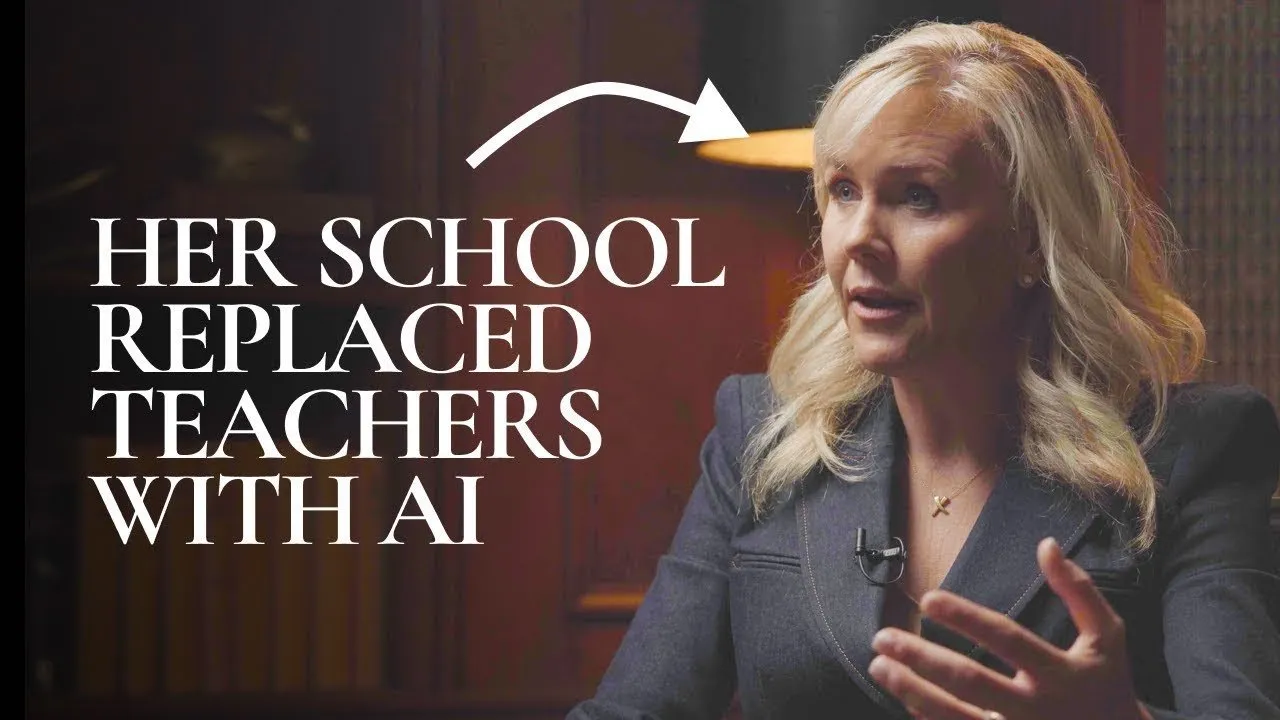
McKenzie Price, co-founder of Alpha School, has spent the last decade proving that the current 8-hour school day is largely inefficient. By leveraging adaptive AI software for core academics, Alpha School students consistently score in the 99th percentile on standardized tests while spending only two hours a day on traditional coursework. The remaining time is dedicated to life skills, grit, and high-agency projects.
This approach challenges the fundamental philosophy of education, shifting the focus from rote memorization to mastery, and from teacher-led instruction to student-led agency.
Key Takeaways
- The Efficiency of Mastery: By using adaptive AI software rather than standard lectures, students can learn two times the amount of material in just 20% of the time usually required.
- The "Jenga Tower" of Knowledge: Traditional schooling forces students forward regardless of comprehension, creating knowledge gaps. AI ensures 100% mastery of foundational concepts before advancing.
- Motivation is 90% of the Battle: The primary challenge in education is not content delivery but engagement. Successful models leverage extrinsic motivators (currency, status, autonomy) to jumpstart intrinsic drive.
- Teachers as Guides: AI replaces the instructional aspect of teaching, freeing human educators to focus entirely on emotional support, mentorship, and motivation.
- Scalability: While currently implemented in private schools, this software-driven model is infinitely scalable, showing promise in environments ranging from elite communities to refugee camps in Malawi.
The Collapse of the Industrial Classroom
To understand why the current system fails, we must look at its origins. The modern school system is largely derived from the Prussian model of the 1800s. Its intent was not to create philosophers or innovators, but to create a standardized citizenry capable of following orders in an industrializing world. As noted by philosophers like Fichte, the goal was often to suppress free will to ensure docility.
In contrast, the aristocratic education of antiquity—the lineage of Socrates tutoring Plato, who tutored Aristotle, who tutored Alexander the Great—was built on one-on-one mentorship. This method is historically proven to be superior, but it was impossible to scale to the masses until the advent of artificial intelligence.
Today, the "teacher at the front of the room" model forces a single pace on 25 different students. If a student misses a concept in 3rd-grade math, the class moves on anyway. This creates what Price calls a shaky "Jenga tower" of knowledge. By the time that student reaches algebra, their foundation is so riddled with gaps that complex understanding becomes impossible. The system creates failure by design, leading students to internalize the idea that they simply "aren't math people."
The 2-Hour Academic Day: How AI Solves Mastery
The core innovation at Alpha School is the condensation of academic work into a focused two-hour block. This is achieved not through a robot teacher or a generative chatbot (which students often use to cheat), but through adaptive learning software. This system acts as a personalized tutor that understands exactly what a student knows, what they don't know, and the precise pace at which they learn.
The Mechanics of Adaptive Learning
Unlike a human teacher who must split attention, an AI tutor monitors a student’s "cognitive load" in real-time. If a student needs five repetitions to master a concept, the AI provides five. If they need fifteen, it provides fifteen. It does not allow the student to move forward until mastery is achieved, ensuring that the "Jenga tower" remains solid.
"In a traditional system, when a student's not doing well, it's usually considered the student's fault. We believe that if a child is not thriving in our system, it's our fault. It's the school's fault."
This efficiency opens up a massive surplus of time. Because the AI handles the instruction, testing, and immediate feedback loop, the "vegetables" of education—math, reading, grammar—are consumed rapidly and effectively. This leaves the rest of the day open for the application of knowledge.
Connecting the Knowledge and Interest Graphs
Generative AI plays a specific role in engagement by overlapping a student's "knowledge graph" (what they need to learn) with their "interest graph" (what they love). If a student struggles with reading but loves the Avengers and soccer, the system can generate reading comprehension passages where the student and their soccer team are the heroes in a Marvel-style adventure. This bespoke content delivery removes the friction from learning, meeting the child exactly where their interests lie.
The 90% Solution: Engineering Motivation
While the technology drives the efficiency, Price argues that AI is only 10% of the solution. The remaining 90% is motivation. Without the will to engage, the best software in the world is useless. Alpha School approaches motivation scientifically, acknowledging that few children are intrinsically motivated to do difficult academic work from the start.
Leveraging Extrinsic Drives
The school utilizes a controversial but effective method: they lean into extrinsic motivation to build momentum. This includes:
- Financial Literacy via Currency: Students earn school currency for hitting academic goals, which they can use to buy items they genuinely want.
- Status and Recognition: The school utilizes leaderboards and public tracking of progress. While some critics view this as "shaming," the data suggests it creates a healthy, high-performance culture where students respect competence and hard work.
- Earning Autonomy: High-performing students can "unlock" time for passions, whether that is video games, sports, or creative projects.
The philosophy is that competence breeds confidence. By using extrinsic rewards to get students over the initial hurdle of difficulty, they eventually develop genuine competence. Once a student realizes they are capable of mastering difficult subjects, their self-view shifts, and intrinsic motivation begins to take over.
Redefining the Role of the Teacher
A common fear regarding AI in education is the displacement of teachers. However, the Alpha model suggests a transformation rather than an elimination. In this system, teachers are reimagined as "Guides."
Since the AI handles lesson planning, grading, and direct instruction, Guides are freed from the bureaucratic drudgery that consumes most modern teachers' days. Instead of spending an average of 22 seconds per student per day on one-on-one interaction (the public school average), Guides spend their entire day providing emotional support, mentorship, and motivation.
Their role is to:
- Identify when a student is disengaged and intervene.
- Teach students how to learn and resourcefulness.
- Provide the human connection and accountability that software cannot.
Beyond Academics: Agency and Life Skills
With academics compressed into the morning, the afternoons are dedicated to life skills—leadership, public speaking, financial literacy, and resilience. The curriculum is designed to force students to grapple with failure in a safe environment.
For example, students engage in high-stakes workshops, such as learning to sail. This culminates in sailing trips where teams must navigate obstacles (and "pirate" parents with water guns) to find treasure. These activities are not merely for fun; they are engineered to teach teamwork and adaptability under pressure.
The "Alpha X" Project
In high school, this evolves into the "Alpha X" project, where students work on capstone endeavors comparable to Olympic-level training in their field of interest. Whether it is pitching a startup to real venture capitalists, building an app with millions of users, or writing a novel, the goal is to produce work that is not just "good for a high schooler," but objectively excellent in the real world.
Conclusion: A Scalable Future
The implications of this model extend far beyond private education. The pairing of low-cost tablets with adaptive AI software makes high-quality, personalized education infinitely scalable. Early pilots with refugee students in Malawi have shown that when provided with the right tools and motivation, students can make rapid academic gains regardless of their socioeconomic background.
By delegating the transmission of knowledge to AI, we allow human educators to return to their most valuable function: shaping character, instilling virtue, and mentoring the next generation. As Price notes, the goal is to unlock human potential by giving every child the Aristotelian education once reserved for kings.