Table of Contents
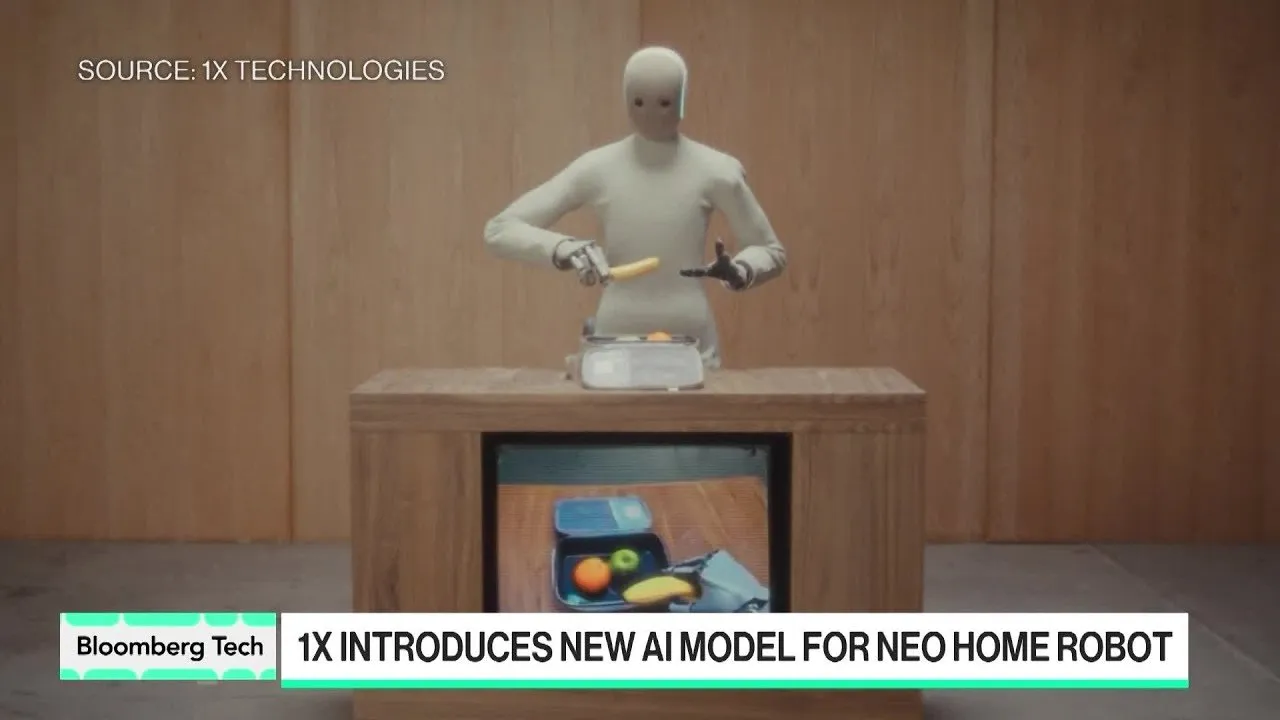
1X Technologies has unveiled a significant update to the AI model powering its humanoid robot, Neo, enabling the machine to perform tasks it has never encountered before without relying on specific training data. In a recent discussion, CEO Bernt Børnich detailed how the new "World Model" architecture allows the robot to reason through physical interactions and learn directly from experimentation, marking a pivot away from the industry's reliance on laborious human data collection.
Key Takeaways
- Zero-Shot Capabilities: The updated model allows the Neo robot to approach and execute tasks, such as reading a Post-it note, without having that specific action in its training dataset.
- Human-Centric Embodiment: Neo’s hardware is designed to mimic human physiology, allowing it to effectively utilize vast libraries of existing human video content for training.
- Intrinsic Safety: The robot combines physical compliance (softness and low energy) with AI alignment to actively reason against risky behaviors.
- New Scaling Laws: Intelligence now scales based on the number of robots deployed and learning in the real world, rather than the volume of teleoperated data gathered by humans.
Reasoning Through Unseen Scenarios
The core advancement in Neo’s software stack is the implementation of World Models, which provide the robot with a fundamental understanding of physics and cause-and-effect relationships. This allows the system to devise a "sensible approach" to novel situations rather than merely repeating memorized motions.
Børnich illustrated this capability with a practical example involving a Post-it note. Although the company possesses no training data showing robots removing sticky notes from a board to read them, Neo successfully reasoned through the task. While the system is not yet infallible, this ability to experiment and self-correct represents a cornerstone of the company's autonomous learning strategy.
"It's all about things being anything that you don't have in your dataset, but still being able to have a sensible approach... Now all you need is the robots teaching themselves how to do all these tasks by actually experimenting and doing this in the real world."
The robot utilizes NVIDIA inference chips to process these complex environmental interactions, highlighting a deep technical collaboration between 1X and the chipmaker.
The Strategic Value of Human Embodiment
A critical differentiator for 1X is the physical design of the Neo robot. Børnich argued that for a robot to effectively learn from the world's existing knowledge base—such as video content on YouTube—it must possess a morphology similar to a human. If a robot’s mechanics diverge too significantly from human anatomy, the transfer of knowledge from human video data to robotic action fails.
This "embodiment" strategy is paired with a focus on safety standards that are essential for allowing robots to learn via trial and error. The company employs a multi-layered safety approach:
- Passive Intrinsic Safety: The hardware is built to be soft, compliant, and low-energy, ensuring that, much like humans, the robot would have to actively attempt to cause harm rather than doing so by accident.
- AI Alignment: The software proactively simulates potential failures, allowing the robot to visualize what could go wrong and select the path with the least risk.
Shifting the Scaling Paradigm
The introduction of World Models suggests a shift in how robotic intelligence will scale in the near future. Traditionally, the bottleneck for humanoid robotics has been the "teleoperation tax"—the need for humans to manually control robots to generate training data.
According to Børnich, once a robot understands the physical world well enough to attempt tasks safely, the learning curve accelerates based on deployment volume rather than manual instruction.
"Your intelligence doesn't scale with the amount of data you can collect with humans anymore. It actually scales with the number of robots you've deployed... now you just want enough robots across society doing enough different tasks so that you get a very large data coverage."
As 1X moves toward wider deployment, the company aims to leverage this self-reinforcing cycle, where a growing fleet of robots generates the data required to reach general robotic intelligence, independent of human data gathering constraints.