Table of Contents
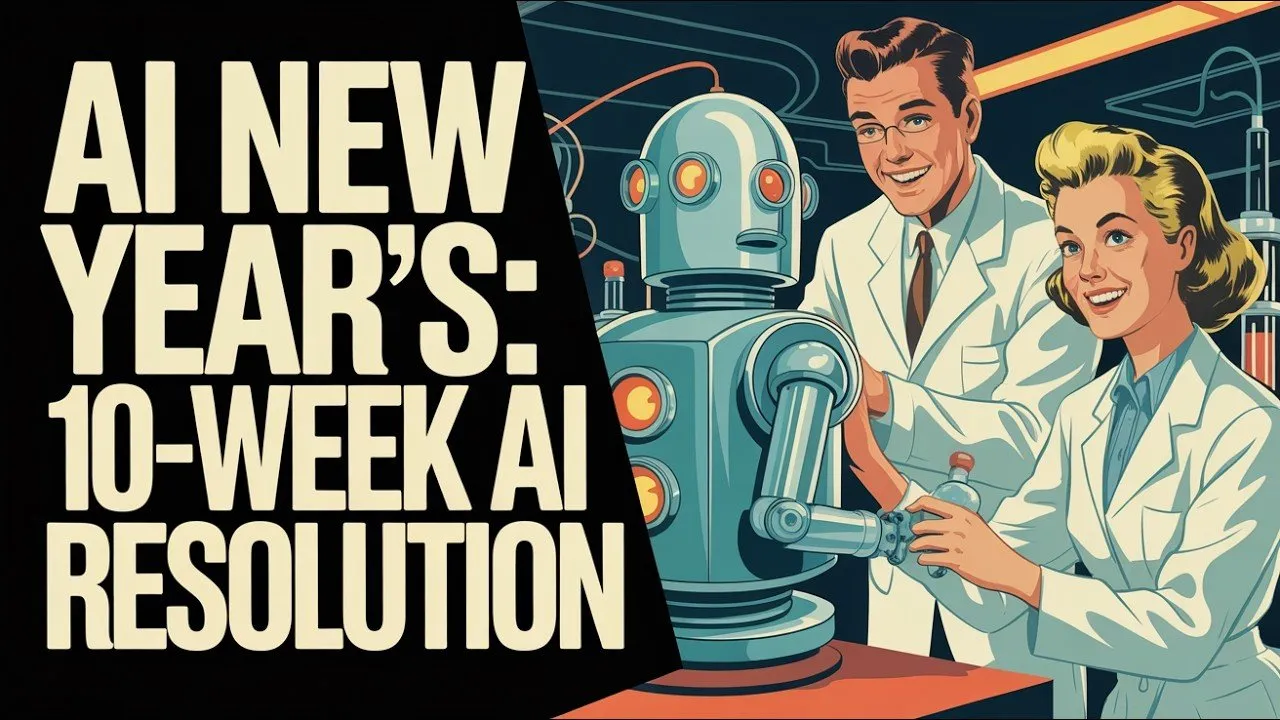
As the technology sector pivots toward 2026, the AI Daily Brief has unveiled a comprehensive "10-Week AI Resolution," a strategic curriculum designed to transition users from casual chatbot interactions to advanced technical fluency. The initiative outlines a self-guided path focused on practical, compounding projects—ranging from "vibe coding" applications to deploying autonomous agents—aimed at establishing a competitive advantage in the evolving digital landscape.
Key Points
- Strategic Upskilling: The curriculum moves beyond basic prompting to cover "vibe coding," automation pipelines, and deep research workflows.
- Tool Agnosticism: The program emphasizes "Model Mapping," encouraging users to identify the strengths of competing platforms like Replit, Lovable, Google AI Studio, and various LLMs.
- Focus on Output: Unlike theoretical courses, each "weekend project" demands a tangible deliverable, such as a deployed web app, a clean data analysis pipeline, or a functioning automation bot.
- Context Engineering: A major focus for 2026 involves creating "Context Documents" to standardize AI memory and reduce repetitive prompting.
- Agent Evaluation: The resolution culminates in stress-testing autonomous agents like Manis and GenSpark for task delegation.
The Shift to "Vibe Coding" and Application Development
A central theme of the 2026 resolution is the democratization of software development through what the industry is calling "vibe coding"—using natural language to program applications without writing raw code. The curriculum begins and ends with these capabilities, highlighting their growing maturity.
The inaugural project tasks users with building a "Resolution Tracker" web application using platforms such as Replit or Lovable. This exercise is designed to demonstrate how rapidly functional tools can be deployed, complete with database tracking, progress bars, and user authentication.
By the tenth week, the curriculum advances to sophisticated application development using Google AI Studio. Users are encouraged to integrate specific AI modalities into their apps, such as embedding conversational voice agents, animating images with VO, or creating context-aware chatbots trained on proprietary data.
"This is not a course in the sense that one thing builds upon another... [It is] practical by default, forcing outputs, not theory."
Deep Work: Research, Data, and Visual Reasoning
The middle phase of the resolution targets the "deep work" capabilities of AI that remain underutilized by the general public. Despite the widespread availability of advanced models, the AI Daily Brief notes that few users stress-test these tools for high-level analysis.
Deep Research and Data Pipelines
Week 3 focuses on a "Deep Research Sprint," challenging users to utilize AI for competitor analysis, pricing strategy, or product research. The goal is to move past accepting the first output by demanding disconfirming evidence and iterative refinement. This is paired with a data analysis project (Week 4) where users must clean raw datasets—such as financial statements or Spotify history—to generate insights, summary tables, and hypotheses testing.
Visual Reasoning
Moving beyond aesthetic image generation, the curriculum introduces "Visual Reasoning" (Week 5). This module requires users to leverage tools like Nano Banana Pro and ChatGPT Images 1.5 to create logic-driven visual explainers. The objective is to produce flowcharts, matrices, or system diagrams that communicate complex ideas more effectively than text.
The Information Pipeline
To address information overload, Week 6 integrates NotebookLM and Gamma into a reusable workflow. Users are tasked with ingesting raw inputs—meeting notes, transcripts, or reports—and automatically converting them into polished executive summaries, FAQs, and presentation decks.
Automation and Context Engineering
As 2026 approaches, the focus shifts from manual interaction to automated systems. The resolution advocates for building a "Minimum Viable Automation Stack" using platforms like Lindy, n8n, or Make.
- Content Distribution (Week 7): Creating automations that trigger off specific events (e.g., a new Slack message) to summarize, format, and route content to various platforms.
- Productivity Loops (Week 8): Implementing inbox management systems that tag, summarize, and draft email responses, or CRM automations that categorize inbound leads.
Critically, Week 9 introduces Context Engineering, a discipline likely to dominate AI workflows in the coming year. This involves creating a "Professional Context Document"—a master file detailing roles, project statuses, and communication preferences. This document serves as a persistent memory layer, allowing users to interface with various models without needing to constantly re-explain their background.
"Most people's mental model is still in chatbot. This weekend is going to update that mental model with firsthand experience of what agents can and can't do reliably."
Looking Ahead: The Agentic Future
The curriculum concludes with a forward-looking "Agent Evaluation Gauntlet." This bonus module pushes users to compare standard Large Language Models (LLMs) against agentic tools like Manis and GenSpark. By running standardized production tasks through these agents, users can develop a "scorecard" to determine which complex workflows—such as end-to-end research synthesis—can be reliably delegated to autonomous systems versus those requiring human oversight.
To support this initiative, a community hub has been launched at aidbnewyear.com, allowing participants to share their trackers, automations, and "vibe coded" applications. As the technology landscape prepares for 2026, this structured approach offers a roadmap for professionals seeking to capitalize on the compounding value of AI fluency.